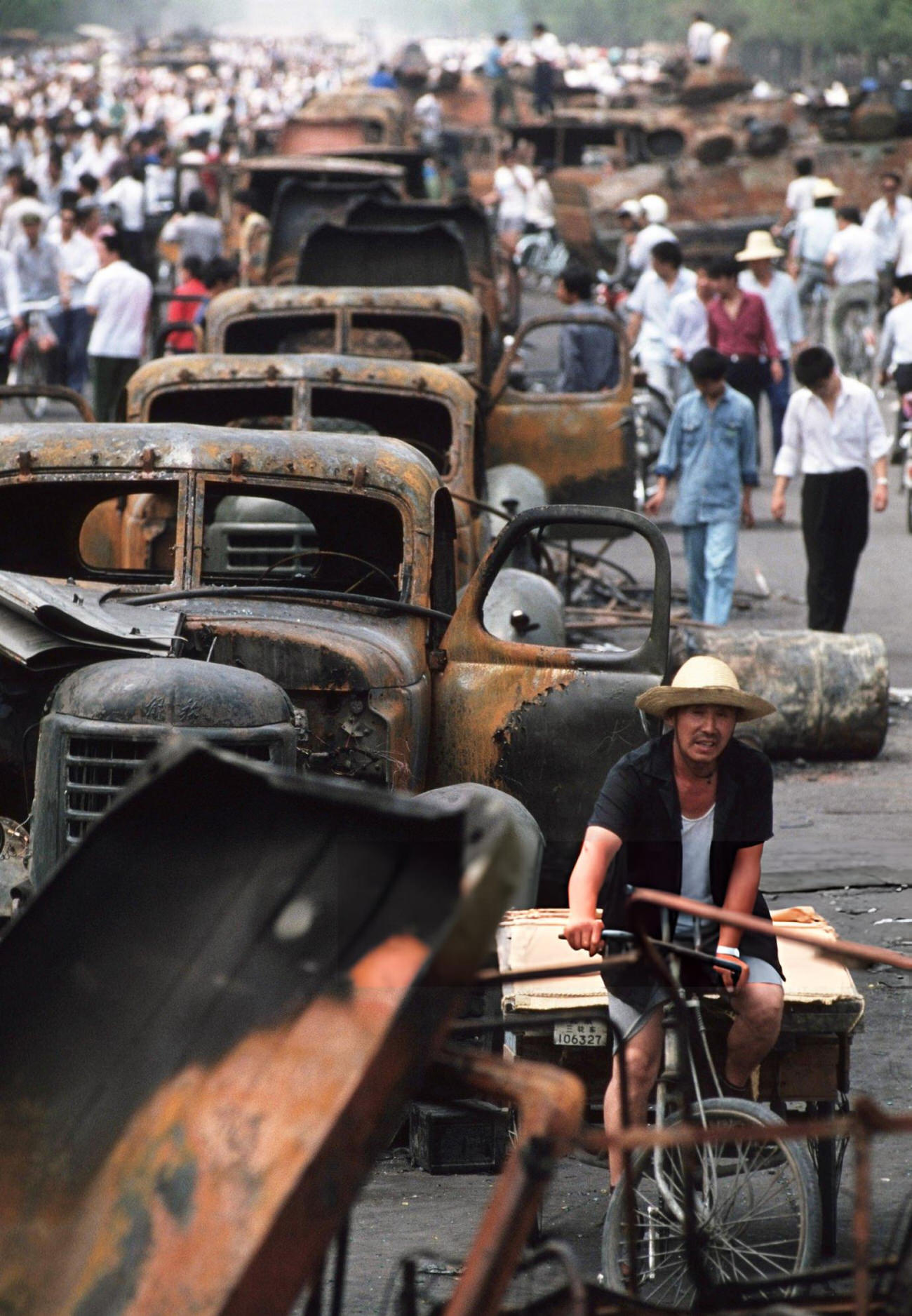
Along a broad city roadway, a line of Chinese Army trucks sits burned and hollowed out, their bodies blistered into rust-brown shells with doors hanging open and windows reduced to jagged frames. The scene is crowded: people cluster in the distance and drift between the wrecks in the foreground, studying twisted metal and soot-stained surfaces as if reading the street like a document. In the nearest corner, a man on a bicycle and cart moves cautiously past the damage, a reminder that ordinary life keeps threading through extraordinary ruins.
The title’s year, 1989, places this moment in a period of acute political confrontation, when military vehicles in public spaces became potent symbols rather than mere machinery. Here, the destroyed convoy suggests a sudden rupture—fire, impact, and the abrupt abandonment of equipment—while the sheer number of onlookers indicates how quickly news and curiosity traveled in an era before smartphones. Faces and clothing remain everyday, but the setting feels tense and unsettled, as though the air still carries the aftershock of recent violence.
For readers interested in civil wars and internal conflict, the photograph offers a stark study of how state power can appear vulnerable once its vehicles are immobilized and exposed to the crowd. The scorched trucks create a corridor of evidence: charred paint, warped panels, and scattered debris that turn the street into an open-air exhibit of upheaval. As a historical photo of China in 1989, it captures the uneasy intersection of civilians, military hardware, and public space—where witnessing becomes its own kind of participation.