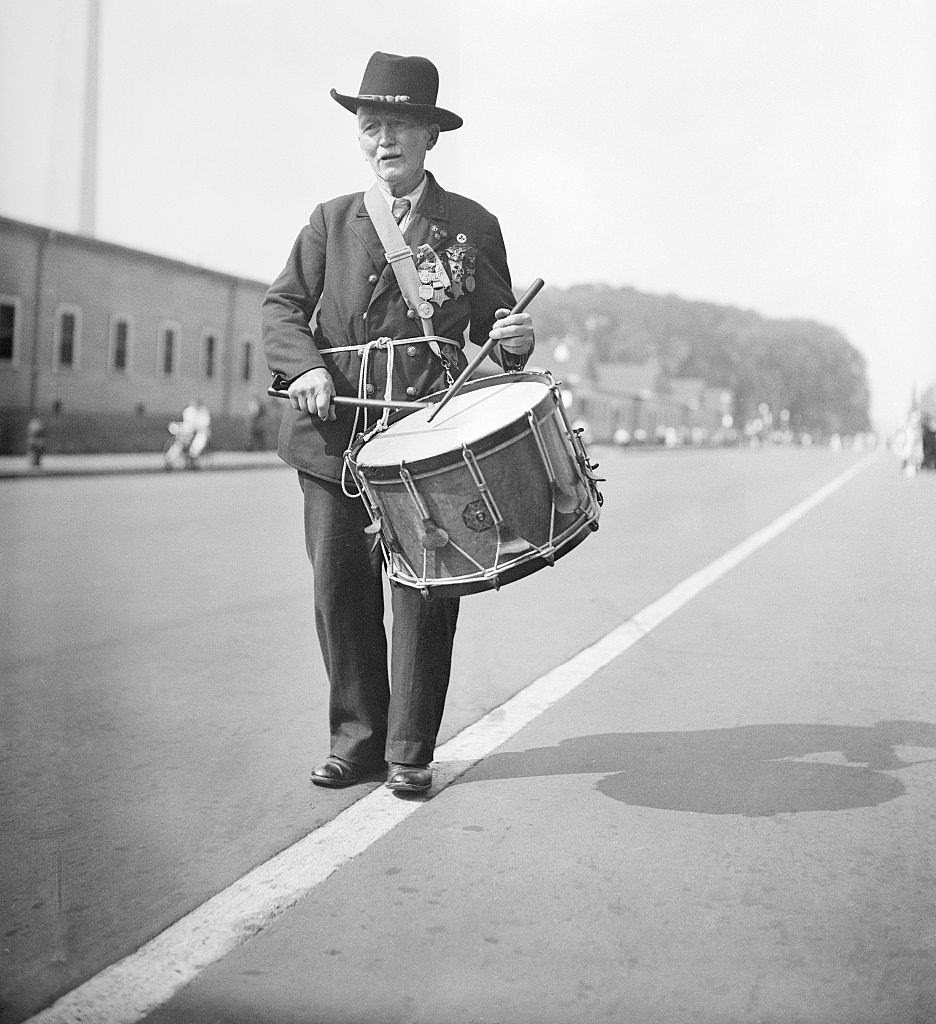
Ninety-year-old Captain R.D. Parker stands in the roadway with a field drum slung at his waist, drumsticks poised as if the next cadence could start at any moment. His dark hat and neatly kept mustache give him a dignified, almost ceremonial air, while the jacket’s clustered medals and pins hint at decades of service and public remembrance. The broad street and distant figures receding into the background place him in a parade-like setting, where the veteran is both participant and living symbol.
According to the title, Parker once played a drum at Abraham Lincoln’s inauguration, an extraordinary claim that turns this 1936 portrait into a bridge between eras. The drum itself—large, rope-tensioned, and meant for marching—evokes the soundscape of 19th-century civic rituals and wartime camps, when rhythm carried orders as surely as it carried pride. Seen through the lens of the 1930s, his presence reads as a carefully preserved connection to the Civil War generation, presented to the public as history embodied.
What makes the scene linger is its quiet mixture of pageantry and time’s weight: a veteran steadying the instrument that once marked national moments, now framed by a modern-looking street and long, open space. For readers searching Civil War history, Lincoln inauguration stories, or 1930s commemorations, this photograph offers a vivid reminder of how Americans curated memory in public view. It invites questions about where such ceremonies took place, who witnessed them, and how one drummer’s life could stretch from the age of Lincoln to the age of cameras and commemorative medals.