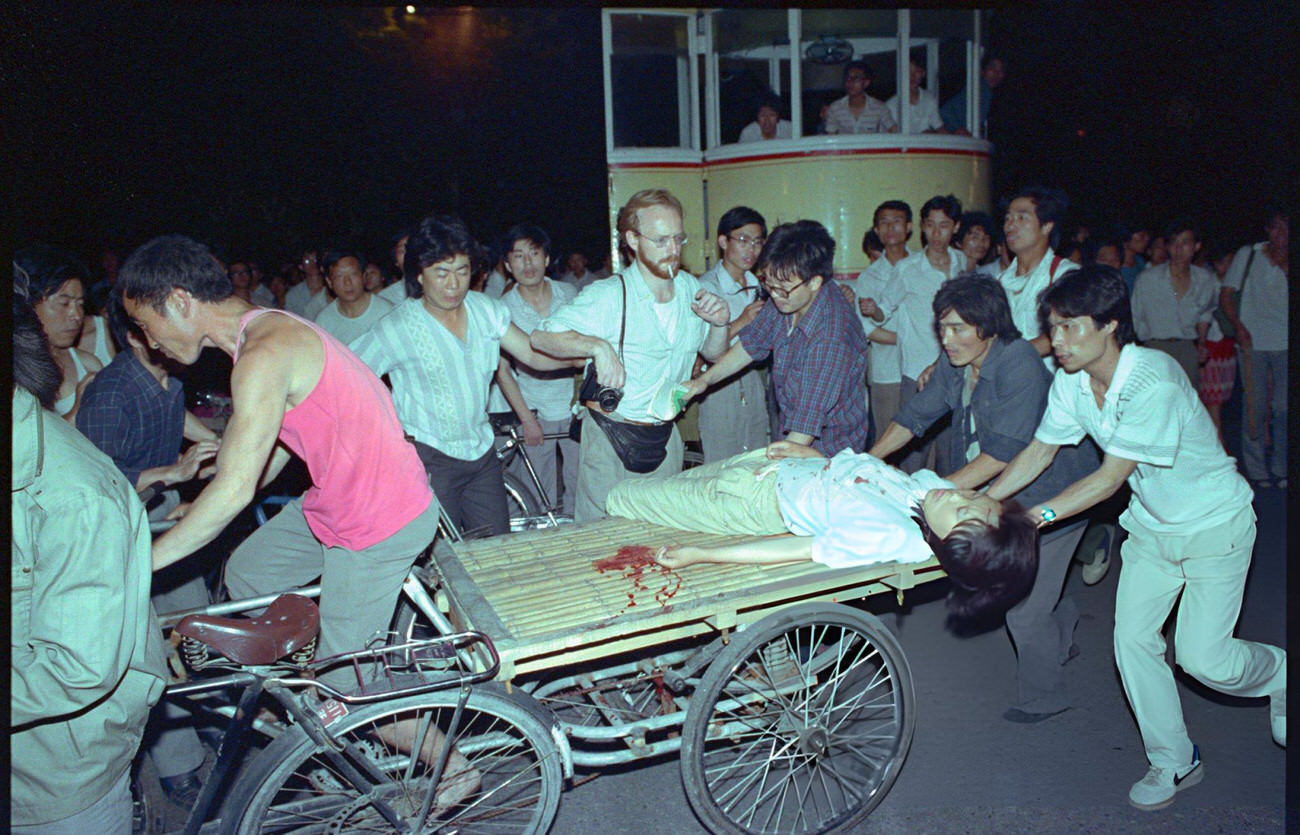
Chaos presses in from every side as a crowd parts to make room for a makeshift stretcher rolling through the night. A wounded woman lies on a wooden platform mounted to a three-wheeled cart, her body rigid and her clothing stained, while several men strain to steer and push. Faces in the surrounding ring register shock, urgency, and the grim focus that takes over when a public space turns into an improvised emergency corridor.
The details pull the viewer into the late–Cold War atmosphere implied by the title, “People transport a wounded woman, 1989,” where civil unrest and sudden violence could transform ordinary streets in an instant. A foreign-looking photographer with a camera slung at his side stands close, documenting as bystanders look on from behind and from a nearby vehicle, underscoring how quickly private suffering becomes a shared spectacle in moments of conflict. Under harsh artificial light, the scene reads like on-the-ground photojournalism: immediate, unfiltered, and difficult to forget.
Seen through the lens of civil wars and internal strife, the photograph speaks to community response when formal systems are overwhelmed or out of reach. The cart—practical, everyday, and unromantic—becomes an ambulance, while the crowd becomes a temporary network of helpers, witnesses, and frightened onlookers. For readers searching for historical conflict photography, 1989 unrest, and civilian experience in war-torn streets, this image offers a stark reminder that history is often carried forward on hurried hands and borrowed wheels.