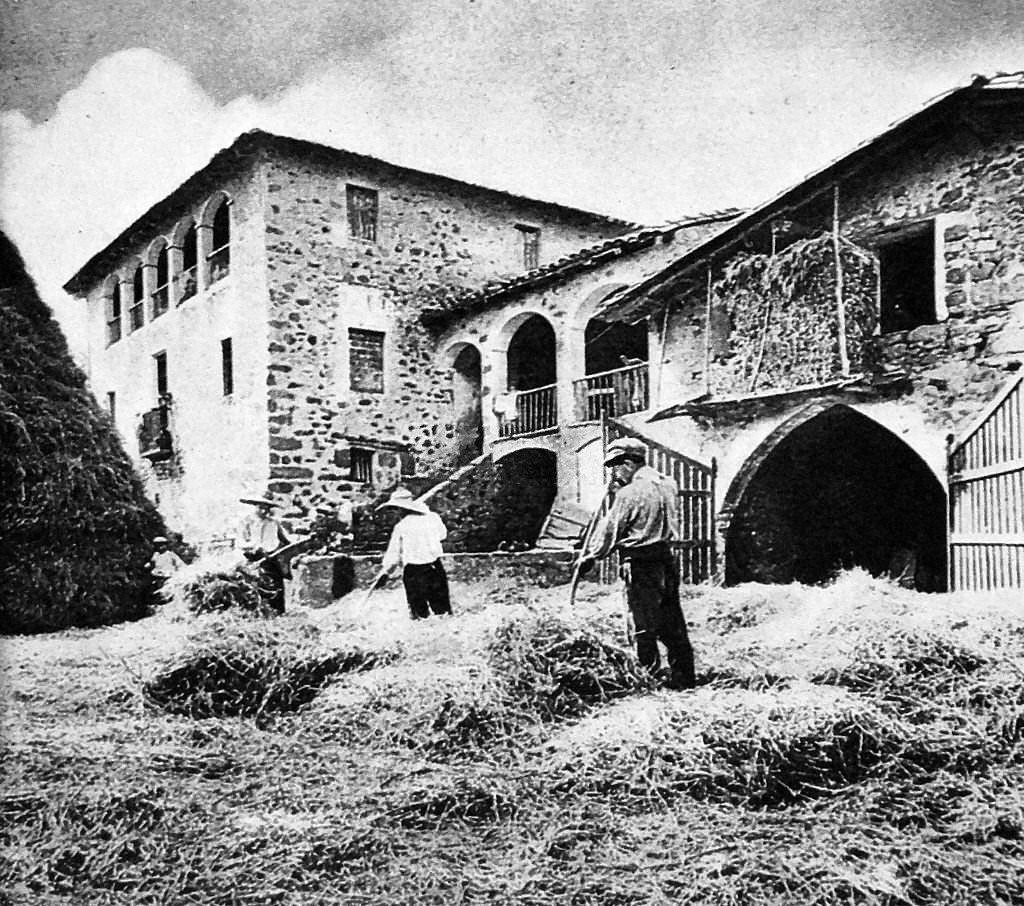
Across a rough farmyard framed by thick stone walls and arched doorways, two workers stand over a wide scatter of straw, tools in hand. The scene feels both ordinary and urgent: a rural household turned into a workplace where every motion—raking, stacking, separating—counts toward keeping people fed. Under a bright sky and beside a large haystack, the labor is plainly communal, rooted in the shared rhythms of the Spanish countryside.
During the Spanish Civil War, the Republican war effort depended not only on the front lines but on the steady output of villages and fields. Photographs like this point to the “rear guard” of agriculture: barns, courtyards, and threshing areas where harvests were organized, stored, and made ready for distribution. Collective work in farm production became a form of endurance, tying local survival to broader wartime needs through cooperative routines and pooled resources.
Stone architecture and simple farm implements anchor the image in a landscape shaped by long tradition, even as conflict pressed new demands onto daily life. For readers searching Spanish Civil War history, Republican logistics, or wartime agriculture, this photo offers a grounded reminder that production was also resistance. Food, fodder, and harvest labor formed a quiet supply line—built from repeated gestures in places like this, far from the sound of guns but close to the necessities of war.