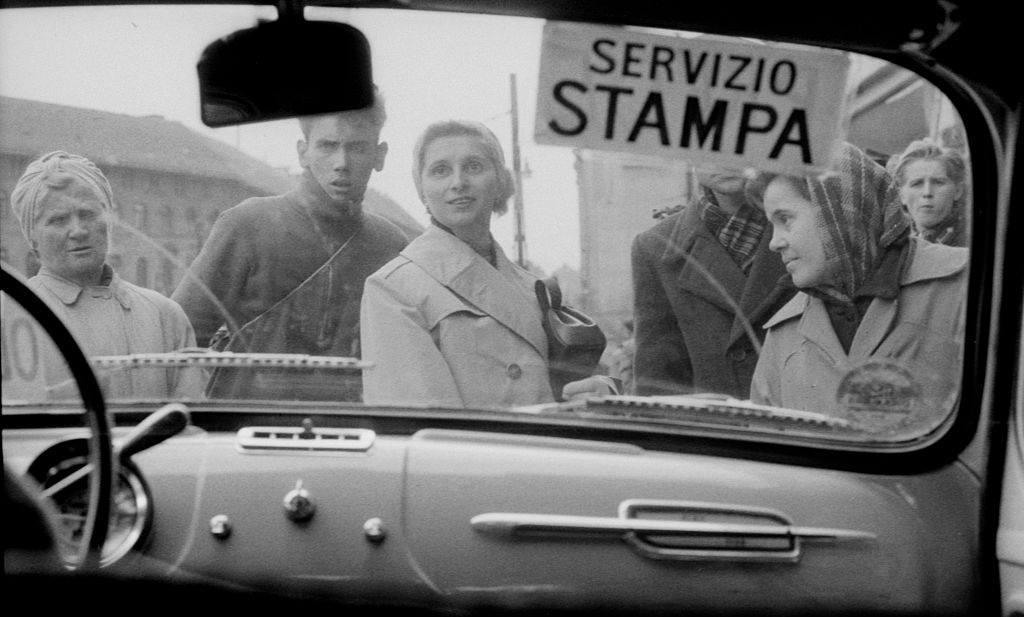
Curiosity presses right up against the glass as local onlookers lean in toward a newly arrived car marked “SERVIZIO STAMPA,” the Italian words for press service. Faces fill the windshield from outside—women in headscarves, a young man craning forward, eyes fixed on whoever sits behind the dashboard—turning an ordinary vehicle into a sudden focal point on a tense street.
According to the title, journalist Massimo Mauri and photographer Mario De Biasi have just reached a Hungarian city to document the uprising against the Soviet regime, and the crowd’s attention hints at how quickly news and rumor traveled in moments of revolt. The perspective from inside the car heightens the sense of vulnerability: the steering wheel and controls sit calm and familiar, while beyond the glass the public sphere feels charged, watchful, and unpredictable.
Civil wars and uprisings are often narrated through grand events, yet this scene lingers on the human scale of history—who gets to see, who gets to record, and how ordinary people react when the world’s eyes arrive. For readers searching for Hungarian uprising photography, Cold War street scenes, or the lived texture of anti-Soviet resistance, the image offers a compelling study in proximity: the press at the center, and a community pressing close to the story as it unfolds.