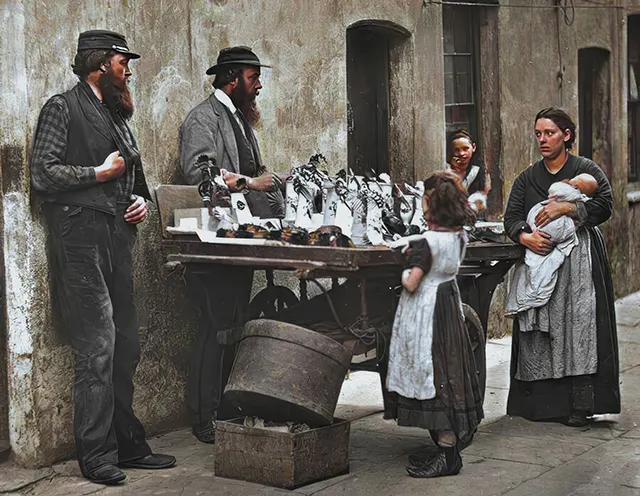
Against a worn plaster wall and a narrow doorway, a small street stall becomes a stage for everyday commerce in the 1890s. Two vendors in workworn coats and brimmed caps stand behind a rough table, their “fancy” goods arranged in neat rows to catch the eye. The colorization brings out textures you can almost feel—dusty stone underfoot, scuffed boots, and the muted tones of a hard-working neighborhood.
Atop the table, bright trinkets and small accessories—ribbons, lace-like pieces, and other decorative items—suggest the kind of affordable finery that promised a touch of style without the cost of a shopfront. A heavy bucket and an open crate sit below, hinting at the portable, make-do logistics of street vending: pack, carry, display, and move on when the day demands it. For anyone searching “street vendors 1890s” or “Victorian era market life,” the scene offers a grounded look at how goods reached people beyond formal stores.
Nearby, a woman holding an infant pauses with a guarded, tired expression, while a child in an apron stands close to the stall as if weighing a choice or waiting to be sent back with a purchase. Another child peeks from the doorway, turning a simple transaction into a snapshot of family life intersecting with the street economy. It’s an intimate reminder that behind every bit of “fancy” merchandise were households counting coins, chasing small comforts, and making their way through an ordinary day.