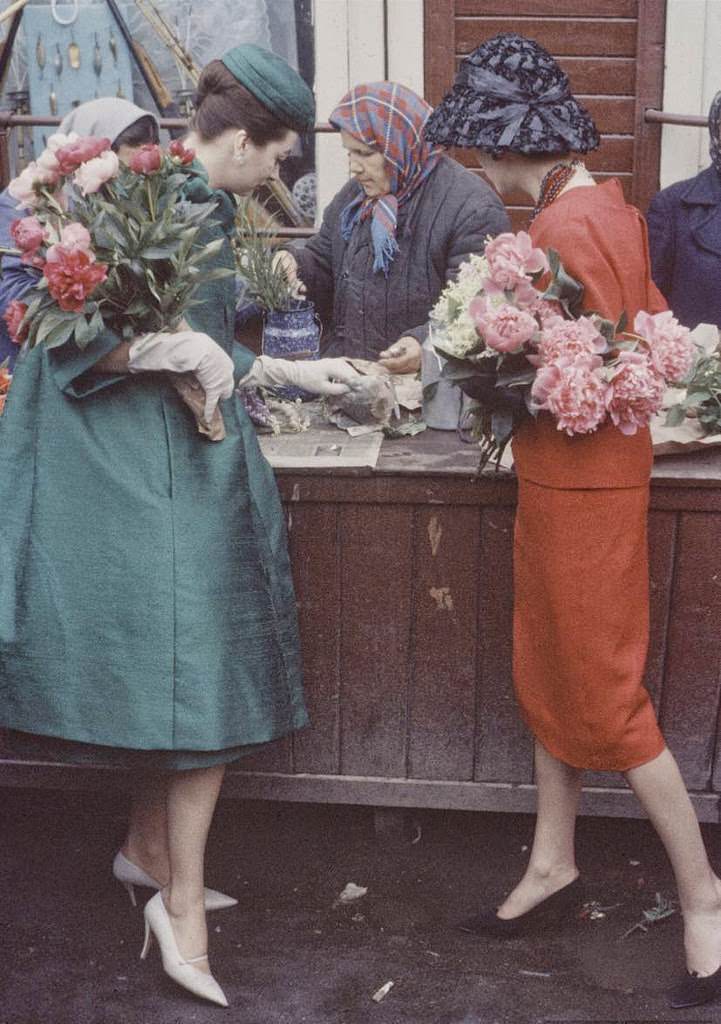
Silk-like color and couture poise collide with the ordinary rhythms of a Moscow street stall in 1959, where two impeccably dressed women pause mid-stride to buy flowers. One wears a deep teal coat with a matching hat and pale gloves; the other, a vivid red suit topped by an extravagant dark headpiece—both carrying armfuls of pink blooms as if the city itself were a runway. The vendor, bundled in a patterned headscarf, anchors the scene in everyday Soviet practicality, creating a striking contrast between haute fashion and daily commerce.
Behind the headline “When Dior Took Over the Soviet Streets,” this moment hints at a larger cultural jolt: Western luxury aesthetics suddenly appearing in a place defined by different ideals of dress, production, and public life. The camera lingers on details—sharp heels on wet pavement, tailored silhouettes, the choreography of hands exchanging money and stems—suggesting how style can become a kind of soft diplomacy, readable even without words. It’s not just about clothing; it’s about visibility, aspiration, and the quiet thrill of novelty in a familiar setting.
For readers interested in Cold War fashion history, Soviet street life, and the story of Dior’s 1959 Moscow sensation, the photo offers a vivid entry point into the era’s contradictions. The flowers feel symbolic: abundant, fragile, and briefly shared across a counter, bridging two worlds for the length of a transaction. Fashion & Culture meet here not in a salon, but at a market table, where the shock of elegance becomes wonderfully tangible.