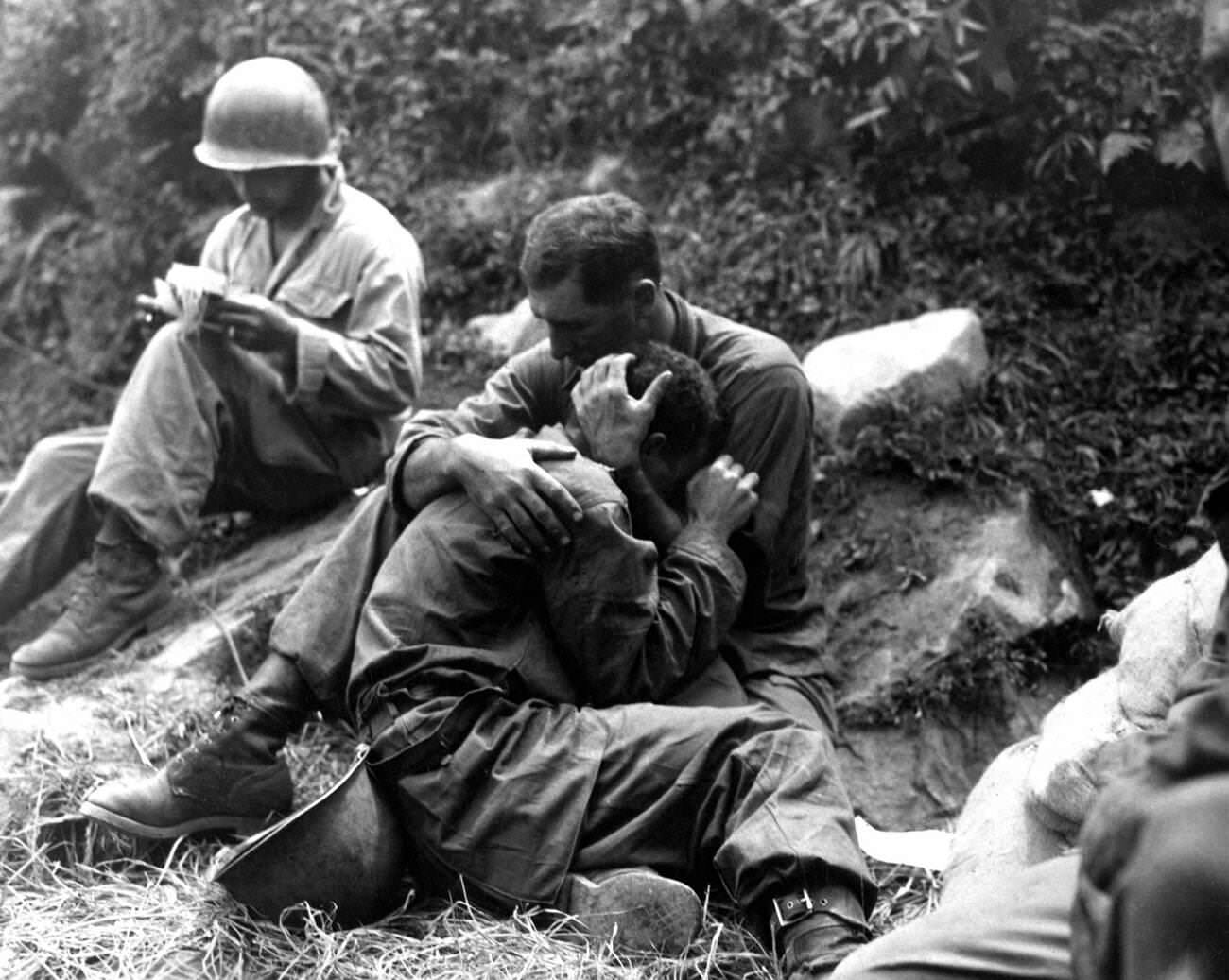
On a rough hillside during the Korean War in 1953, an American soldier cradles a comrade who appears overcome by grief or shock, one arm wrapped firmly around his shoulders and a hand steadying the back of his head. Their uniforms are rumpled from field conditions, boots planted in dry grass as they sit among rocks and low brush, seeking a moment of shelter from the turmoil beyond the frame. The closeness of the gesture draws the eye to the human cost of combat, where endurance is measured not only in miles marched but in the ability to keep going after what has been seen and lost.
Behind them, a helmeted soldier sits apart, absorbed in what looks like a letter or papers held in both hands, a quiet counterpoint to the embrace in the foreground. That small separation suggests how wartime emotions can share the same space—one man shut inward with words on a page, another collapsing into the only comfort available: a fellow soldier’s steady presence. The surrounding vegetation and uneven ground hint at a temporary halt in movement, a pause carved out of an active war for tasks that rarely make it into official reports—reading, waiting, and holding on.
Moments like this shape the memory of the Korean War as much as images of front lines and hardware, because they reveal the bonds that formed under pressure and the trauma that followed soldiers into every lull. For readers searching for Korean War history, American soldiers in 1953, or candid wartime photographs of compassion, this scene offers an unvarnished reminder that the battle was fought in hearts and minds as well as on terrain. It stands as a quiet testament to camaraderie: when words fail, an arm around a friend can be its own kind of medicine.