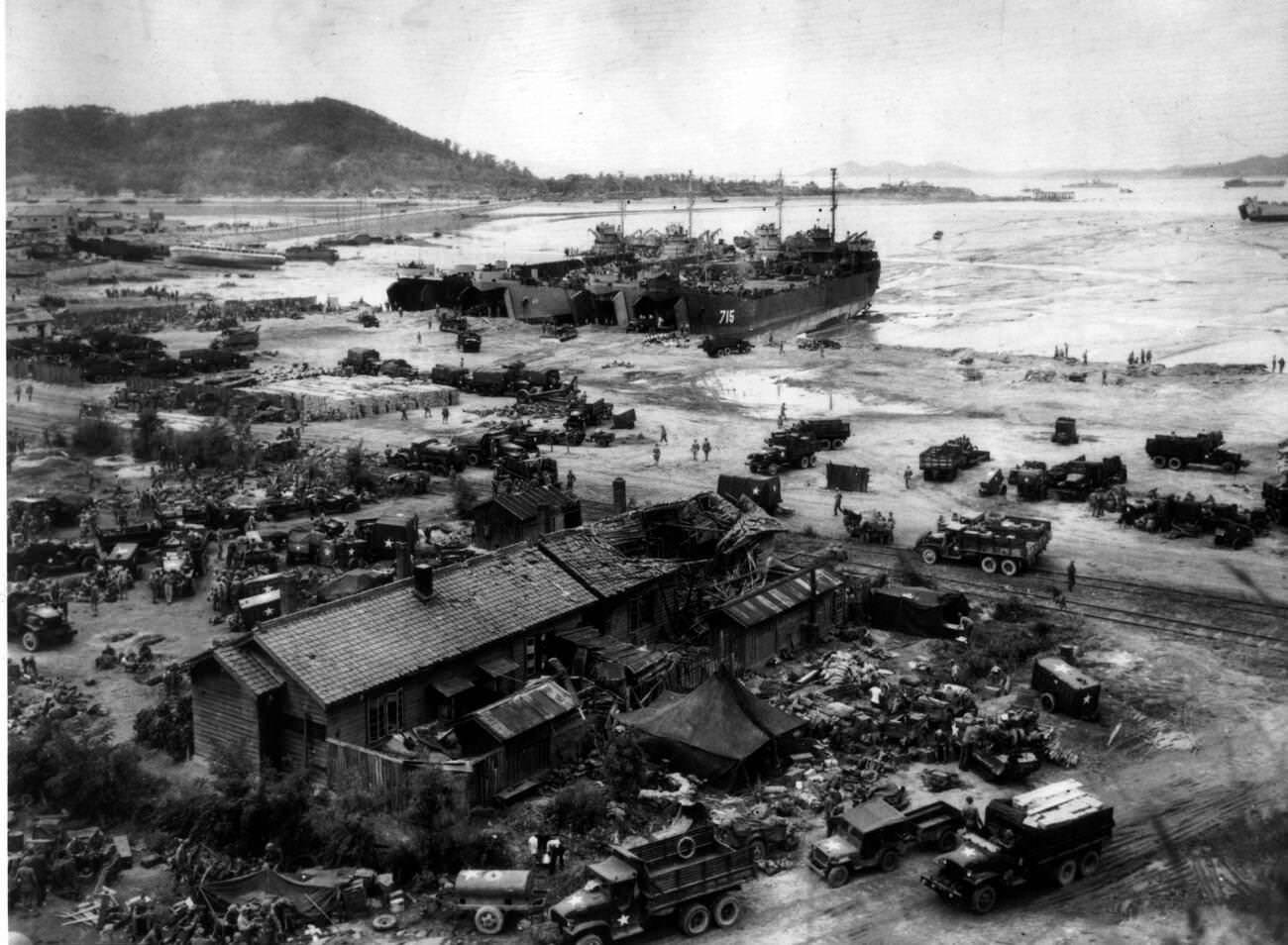
Mud flats stretch toward the waterline as landing ships sit heavy at the edge of the tide, their ramps open to a steady stream of vehicles and supplies. Trucks marked with military insignia cluster in makeshift rows, while small groups of troops move between cargo piles and improvised pathways. In the foreground, battered buildings and scattered debris underline how quickly a working waterfront can become a battlefield staging ground.
Inchon in 1950 is often remembered for its daring amphibious gamble, and this scene brings the logistics into sharp focus—less a single dramatic moment than an entire system grinding into motion. The shoreline is crowded with transport, equipment, and men coordinating under open sky, suggesting the immense effort required to land, organize, and push inland. Even at a distance, the composition conveys urgency: ships, shore parties, and vehicles stitched together in a temporary port built on speed.
For readers exploring the Korean War and the Invasion of Inchon, this historical photo highlights the practical realities behind the headlines: tides, terrain, congestion, and the constant movement of materiel. It also echoes the broader theme hinted by “Civil Wars,” where civilians’ spaces—homes, docks, roads—become contested ground with lasting scars. As a WordPress archive piece, it serves as a vivid reference for anyone researching amphibious landings, Korean War military operations, and the visual history of 1950.