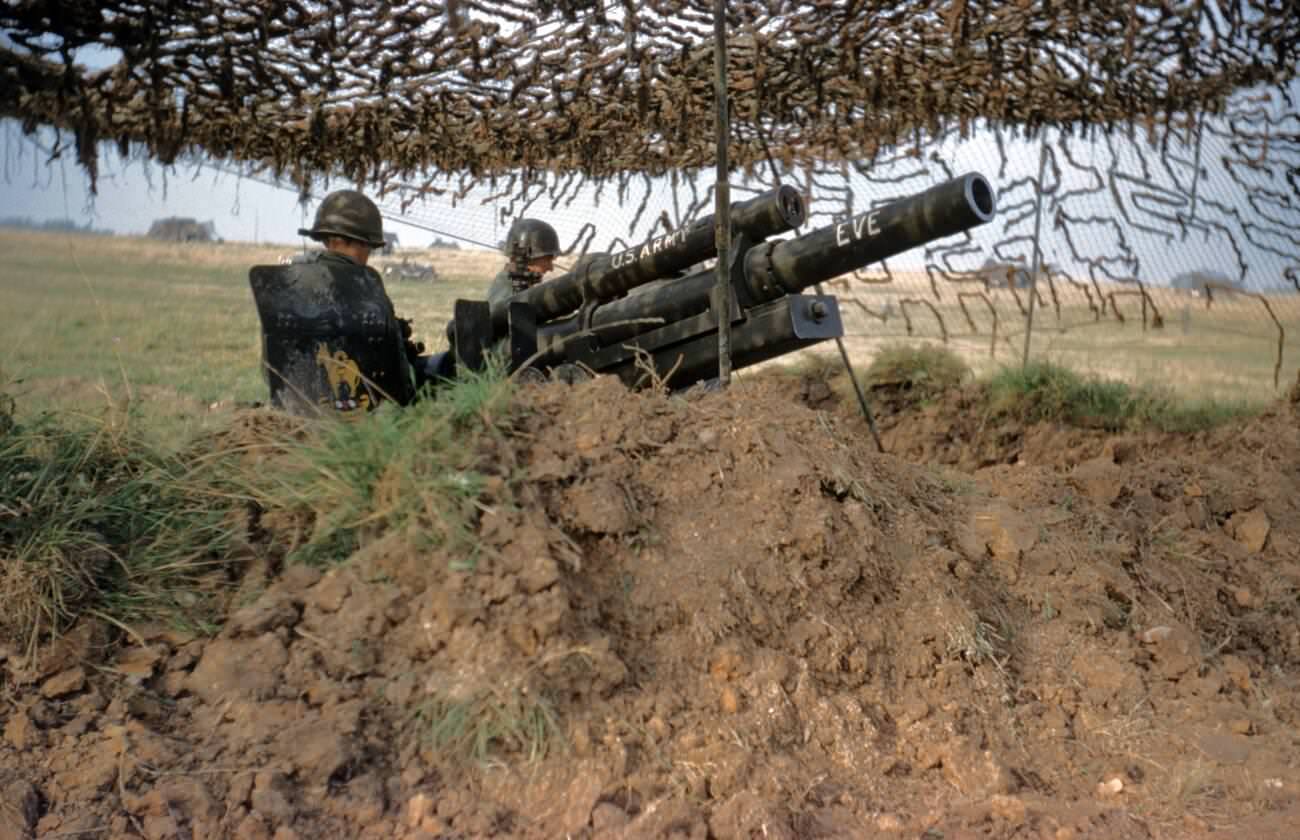
Under a rough camouflage net, two helmeted U.S. Army soldiers crouch behind an emplaced field howitzer, its long barrel pushed out toward an open, grassy landscape. Freshly turned earth and a low berm frame the gun position, suggesting a hurriedly prepared firing pit designed to hide the crew and blunt incoming fire. The scene feels both exposed and protected at once—wide ground ahead, but a tight, workmanlike shelter around the weapon.
The title points to the light field howitzer M101/M2 in 105 mm (often described alongside “4.1 inch” in period references), a staple of American artillery through the Korean War era. Markings on the barrel and the practical, stripped-down setup emphasize utility over ceremony: this is a tool meant for sustained support, not display. Details like the spade bracing and the layered camouflage speak to the rhythm of artillery service—dig in, conceal, aim, and wait for the next call for fire.
For readers searching Korean War US Army artillery, M101 howitzer history, or 105mm field gun photos, this image offers a grounded look at how mid-century crews operated in the field. It conveys the everyday labor behind “big” events: the careful placement of a gun, the discipline of staying low, and the constant negotiation between mobility and cover. Even without a named unit or precise location, the photograph preserves the texture of 1950s-era warfare—mud, canvas, steel, and watchful attention over a quiet horizon.