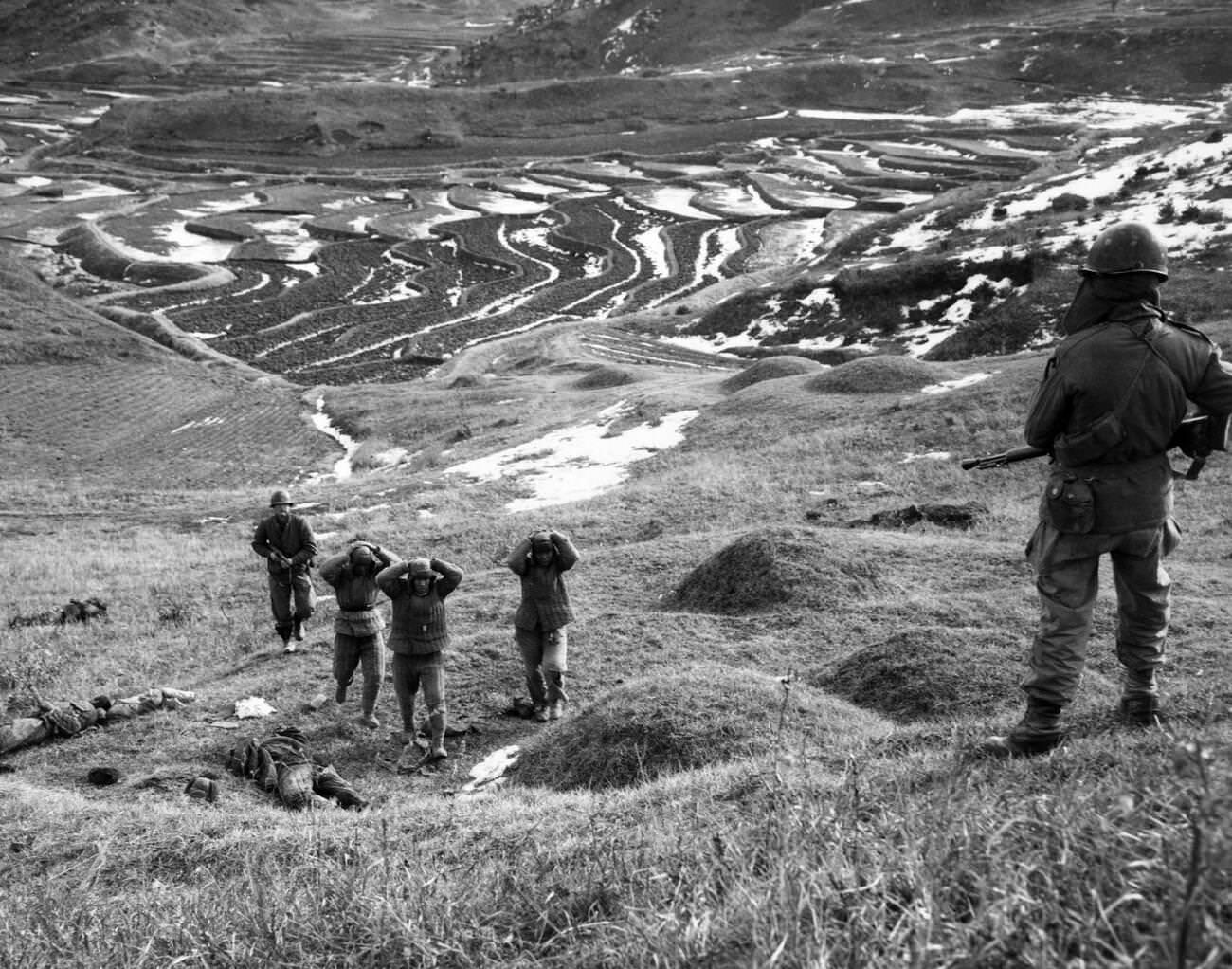
High on a windswept hillside, a lone guard with a rifle watches as captured soldiers move forward with their hands clasped on their heads, the posture of surrender stark against the open landscape. Behind them, terraced fields and water-filled paddies spread across the valley like a map, reminding us how closely the Korean War’s front lines pressed against everyday farmland. In the foreground, bodies and scattered gear lie in the grass, a grim punctuation that turns the scene from simple custody into a record of immediate, violent aftermath.
The title “Korean War, POW’s, 1951” anchors the moment in the conflict’s grinding middle phase, when patrols, ridge fights, and sudden reversals produced prisoners as often as they produced casualties. The contrast between the calm geometry of the fields below and the tense, controlled movement on the slope above captures a defining truth of wartime Korea: combat unfolded in places that were also homes, harvests, and livelihoods. Even without a named unit or pinpointed location, the photo conveys the uneasy balance of authority and vulnerability that surrounds prisoners of war.
For readers exploring Korean War history, POW narratives, and battlefield photography, this image offers more than documentation—it offers atmosphere, scale, and consequence in a single frame. It invites questions about what happened just before the shutter clicked, where these captives were taken, and how such encounters shaped the broader war in 1951. Filed under “Civil Wars,” it also echoes a wider theme of divided societies, where the line between neighbor and enemy could run through the same valleys and hillsides.