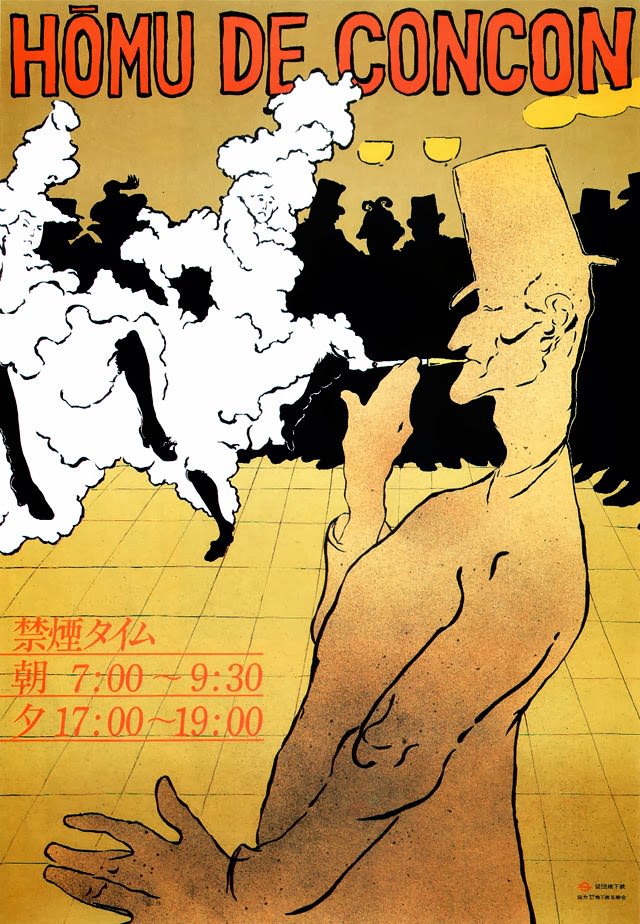
Bold block letters at the top—“HŌMU DE CONCON”—set a comic-book tone for a sharp public message, while a lone commuter in a tall hat turns away to cough into his hand. Behind him, a crowd on a station platform dissolves into dark silhouettes, partly obscured by a swelling cloud that reads as smoke, breath, and contamination all at once. The warm, mustard-yellow background and heavy black shapes give the scene a gritty, urban feel that fits the title’s January 1979 mood.
What makes the artwork striking is how it translates an everyday moment—coughing in public—into a visual warning about shared air and shared space. The exaggerated plume pushes leftward like an invisible force, connecting the figure to the anonymous mass and hinting at how quickly discomfort spreads in a commuter crush. Even without a specific named place, the platform tiles, packed bodies, and theatrical typography ground it firmly in the world of trains, rush hours, and public etiquette.
Japanese text in the lower-left corner includes a “no smoking time” notice with hours listed, tying the coughing theme to concerns about smoke and respiratory irritation in transit areas. Read today, the poster-like composition feels ahead of its time: part social commentary, part health reminder, and entirely rooted in the lived experience of public transportation. For anyone searching railway history, vintage poster art, or 1970s public health messaging, “Coughing on the platform (January 1979)” offers a memorable glimpse into how cities tried to manage the air we all breathe.