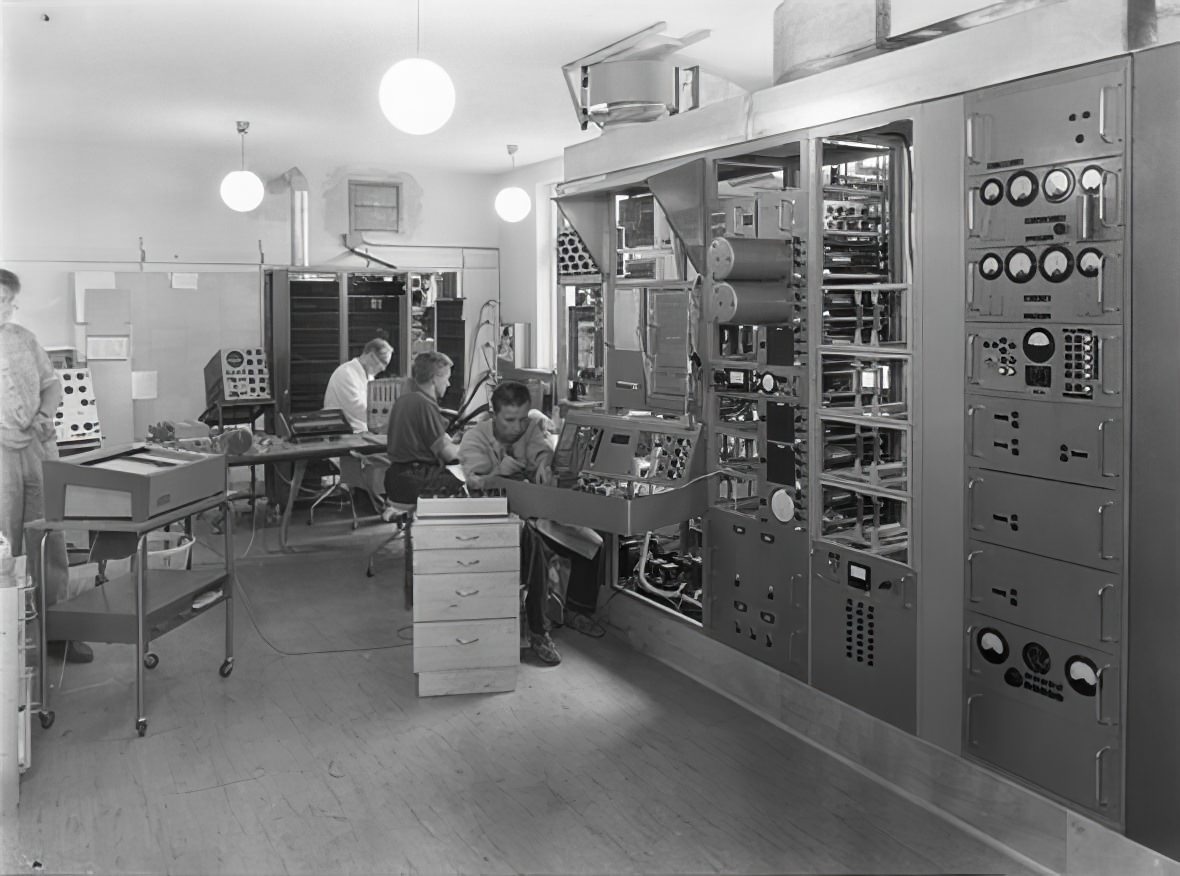
Rows of tall cabinets line the wall, their faces crowded with dials, meters, and switches, while technicians lean in close to adjust and test the circuitry. The room feels half laboratory, half workshop: open racks reveal dense components, cables snake toward a central console, and bright ceiling lamps cast an even glow over careful hands and concentrated posture. It’s an atmosphere of experimentation where “computer” meant hardware you could walk around, listen to, and repair in real time.
Long before modern computer departments defined the field, NTNU’s computing story was already taking shape through DIANA—the DIfferential ANAlysator—an analog electronic computer built by Jens Glad Balchen and the Division of Cybernetics in the years between 1952 and 1955. In an era when digital machines were still rare and remote, analog systems like this were designed to model and solve problems by representing changing quantities directly, turning mathematics into measurable signals. The photograph underscores that early computer history was as much about instruments and engineering craft as it was about abstract code.
For readers interested in inventions and the roots of cybernetics at NTNU, this image offers a grounded glimpse into how pioneering research actually looked day to day: calibration, maintenance, and iterative building inside a dedicated technical space. The scale of the equipment and the density of controls hint at the ambition behind DIANA, a step that helped shape later work in control systems and computing. Seen today, it reminds us that the university’s “computer history” began with bold analog experimentation, not with the administrative boundaries of later departments.