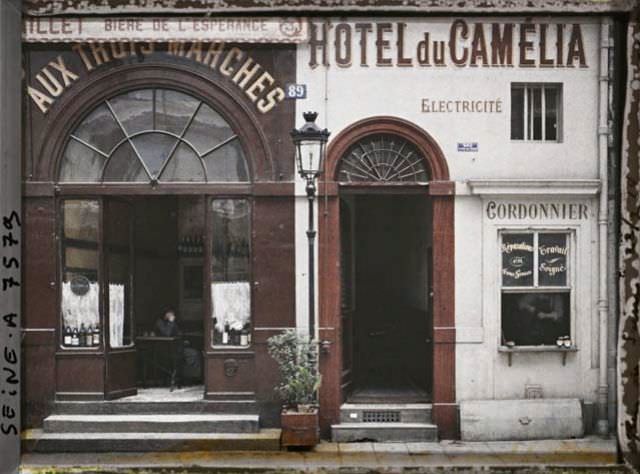
At 89 rue de Seine, Stéphane Passet frames a lively slice of Parisian street life where typography and architecture compete for attention. Bold painted lettering advertises “Hôtel du Camélia,” while the arched storefront beside it—marked with “aux touristes” and “marchés”—invites the eye through glass panes and a deep entryway. The colorization brings out the warm reds of the stone surrounds, the creamy facade, and the subdued patina of a well-worn neighborhood block.
Details reward a slower look: “Électricité” is proudly painted on the wall, hinting at modern convenience making its way into everyday lodging, and a classic streetlamp stands like a punctuation mark between doors. The number 89 appears near the arch, anchoring the scene in a specific address, while “cordonnier” on the right signals the presence of a shoemaker, a reminder of the small trades that once clustered along busy streets. Curtains, window reflections, and the shadowed interior create a layered sense of depth, as though the street has momentarily paused for the camera.
For readers searching for early color photography, Paris colorized images, or Stéphane Passet photographs, this post offers a richly legible streetscape full of period signage and storefront character. It’s a portrait of urban commerce rendered in paint, glass, and stone—hotel, shop, and workshop sharing one facade and one address. Even without a stated date, the scene speaks clearly of a transitional era when traditional trades, tourism, and new technologies met along the Left Bank.