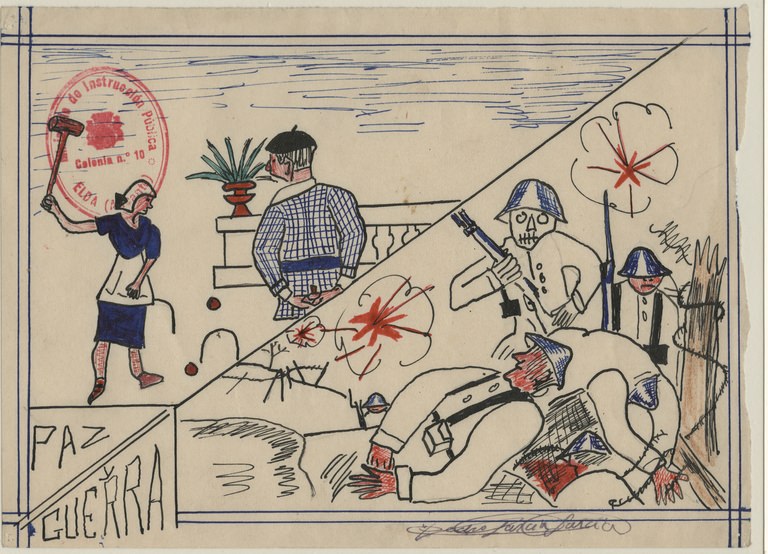
A diagonal slash cuts the composition into two worlds, and the title “Peace:War” makes that split feel immediate and moral. On the calmer side, a domestic terrace with a balustrade and a potted plant suggests ordinary life continuing—someone stands with hands behind their back while, nearby, a figure raises an arm in a gesture that reads like scolding, warning, or rallying. The simple, poster-like linework and blocks of color give the scene the directness of a street placard or a quick, urgent drawing meant to be understood at a glance.
Across the dividing line, war intrudes with helmeted soldiers, rifles, and bodies collapsing into the foreground, punctuated by red marks that evoke blood and impact. The figures are sketched with a stark, almost childlike economy, which only heightens the brutality: faces become masks, movement becomes sprawl, and the ground itself feels unstable. It’s a visual argument as much as an artwork—peace is ordered space and human posture; war is fragmentation, injury, and the loss of individuality.
“Pedro García Alicante” in the post title anchors the piece to Spanish cultural memory without requiring a single fixed date or battlefield. The hand-drawn text “PAZ” and “GUERRA” reinforces the bilingual bluntness of the message, making the artwork searchable and resonant for readers exploring anti-war art, Spanish political graphics, or twentieth-century social commentary. As a historical image for a WordPress post, it invites reflection on how artists distill public trauma into symbols, and how a single line across a page can separate the everyday from catastrophe.