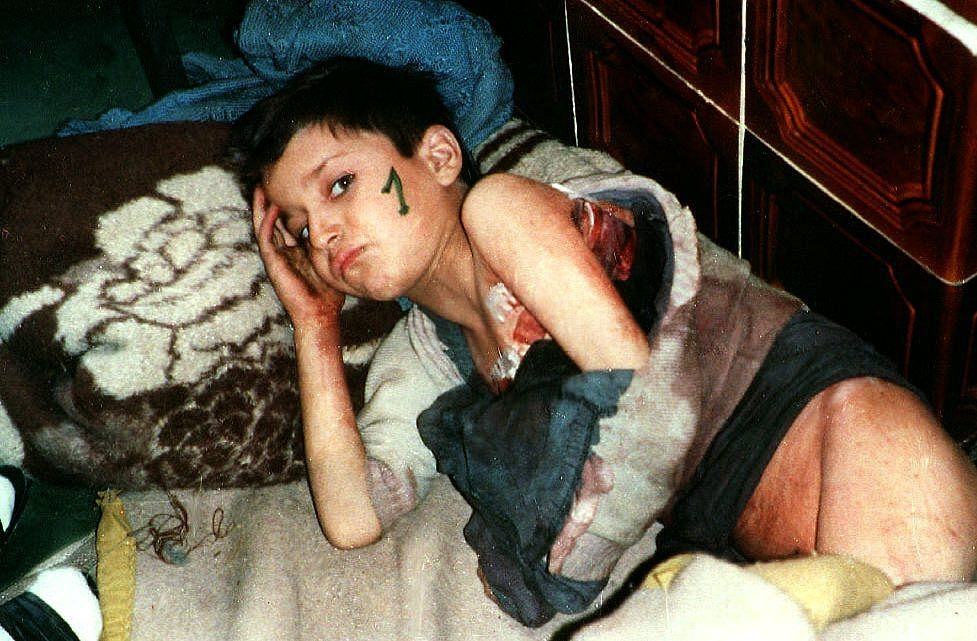
A small boy lies curled on a makeshift hospital bed, his body thin with hunger and strain, one hand propping up his head as if the simplest movement costs too much. A dark mark on his cheek and visible injuries on his torso draw the eye, while the rough layering of blankets and clothing hints at improvisation under pressure rather than proper medical care. The room feels cramped and dim, more like a shelter than a ward, with the bed pressed close to a large piece of furniture and belongings tucked wherever space allows.
The title places the scene in Srebrenica in 1993, during the Bosnian War, when civilians were trapped between front lines, shortages, and fear. In that context, the word “evacuation” carries its own tension—part hope, part uncertainty—suggesting a waiting that could stretch for hours or days, depending on access, security, and the shifting decisions of armed forces and aid organizations. Rather than showing combat, the photograph confronts the quieter violence of civil war: malnutrition, untreated wounds, and the exhaustion that settles into a child’s expression.
For readers searching for Srebrenica 1993, Bosnian War civilians, or historical photos of wartime medical care, this image offers a stark, intimate record of survival under siege. It also raises uncomfortable questions about what it meant to be “safe” in a place where even a bed had to be improvised and childhood could be reduced to waiting for transport. Seen today, the photograph stands as a reminder that the human cost of civil wars is often measured not only in battles, but in the fragile pauses between them.