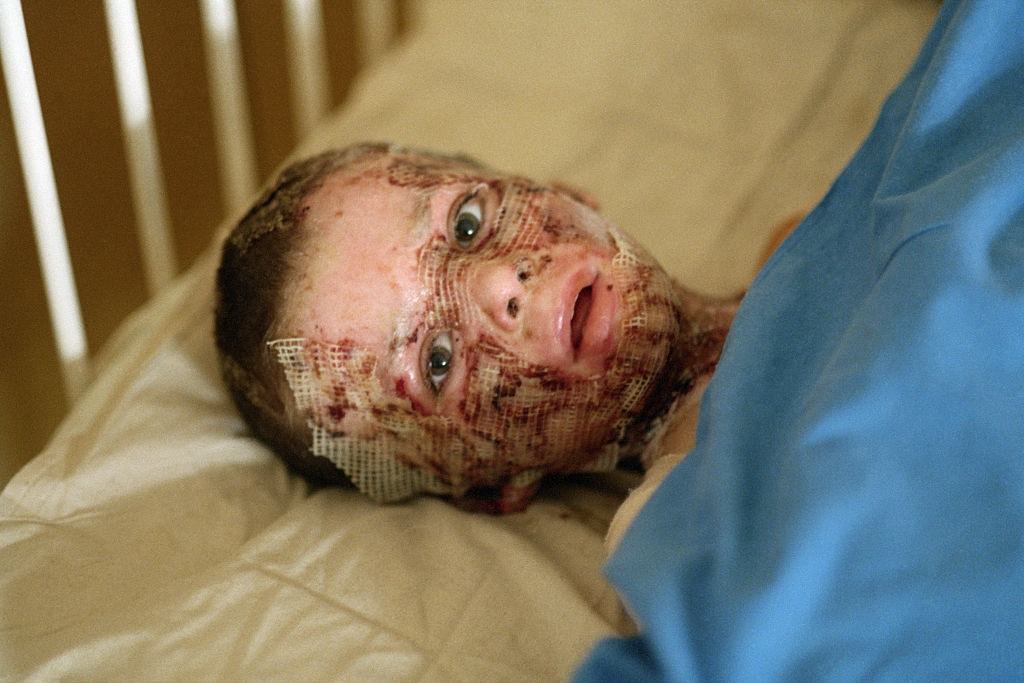
On a hospital pillow, four-year-old Jasmin Hreljic lies wrapped in blue bedding, his face carefully covered with gauze and dressings that map the aftermath of a kerosene lamp explosion. The camera lingers close enough to catch the shine of his eyes and the raw texture of treatment—small details that turn a headline into a child’s immediate reality. A bed rail and plain linens frame the scene with stark simplicity, emphasizing how quickly ordinary life can be interrupted by sudden injury.
The setting is Sarajevo’s children’s hospital, a place where civilian suffering and medical care meet in the most intimate way. Burns demand time, precision, and repeated attention, and the layered bandages suggest both protection and fragility as healing begins. In the context of civil wars, this kind of accident also hints at disrupted infrastructure and the reliance on dangerous household fuels when safer options are scarce.
Beyond the clinical moment, the photograph speaks to resilience and the quiet labor of caregivers who work under pressure, often with limited resources. It invites readers to consider how conflict reaches into kitchens and bedrooms, transforming everyday objects like lamps into hazards. As a historical photo, it stands as a sober reminder that wartime stories are not only told at the front lines, but also in children’s wards where recovery becomes another form of survival.