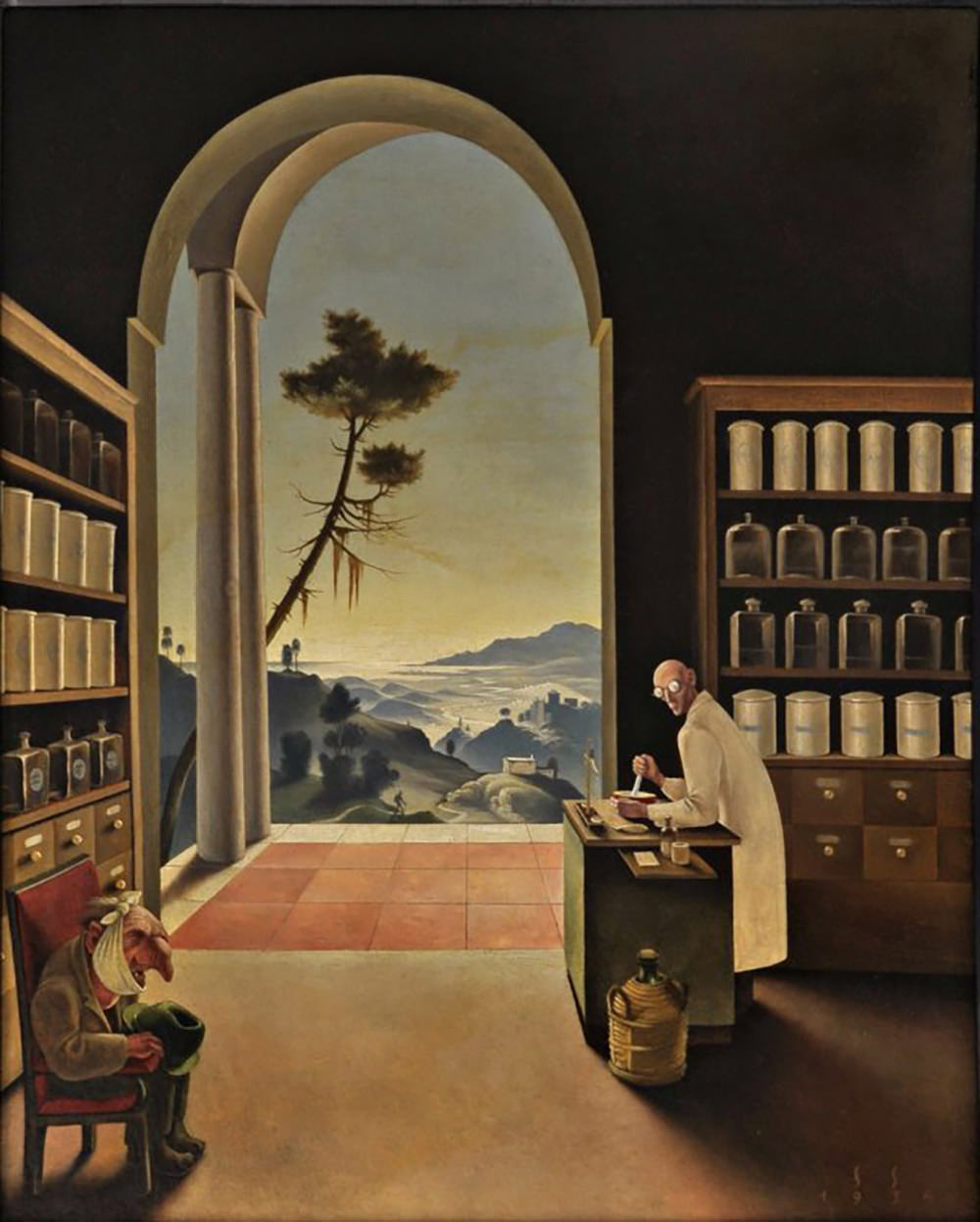
Franz Sedlacek’s *Die Apotheke (The Pharmacy)* from 1934 places the quiet drama of medicine inside a space that feels both orderly and uncanny. Tall shelves of jars and tins line the room like a catalogue of remedies, while a pharmacist in a white coat bends over a mortar and pestle at a tidy counter. In the lower corner, a seated figure slumps with a vessel in hand, turning the shop into a stage where care, fatigue, and waiting share the same hush.
At the center, an oversized archway opens the interior onto a distant landscape—rolling hills, a pale sky, and a solitary tree—so that the pharmacy becomes a threshold between the measured world of bottles and the vastness beyond. The clean geometry of the tiled floor and columns contrasts with the organic shapes outside, heightening the surreal tension that Sedlacek is known for. Light seems to drift in from the horizon, softening edges and making the stillness feel intentional, almost ceremonial.
Seen today, the painting reads as more than a genre scene; it’s a meditation on modernity, science, and the fragile human body, told through meticulous detail and controlled atmosphere. For readers searching for Franz Sedlacek art, 1930s European painting, or surrealist-leaning visions of everyday work, *The Pharmacy* offers an unforgettable blend of realism and dream logic. The result is an artwork that invites close looking—at the containers, the gestures, and the uneasy calm that lingers in the air.