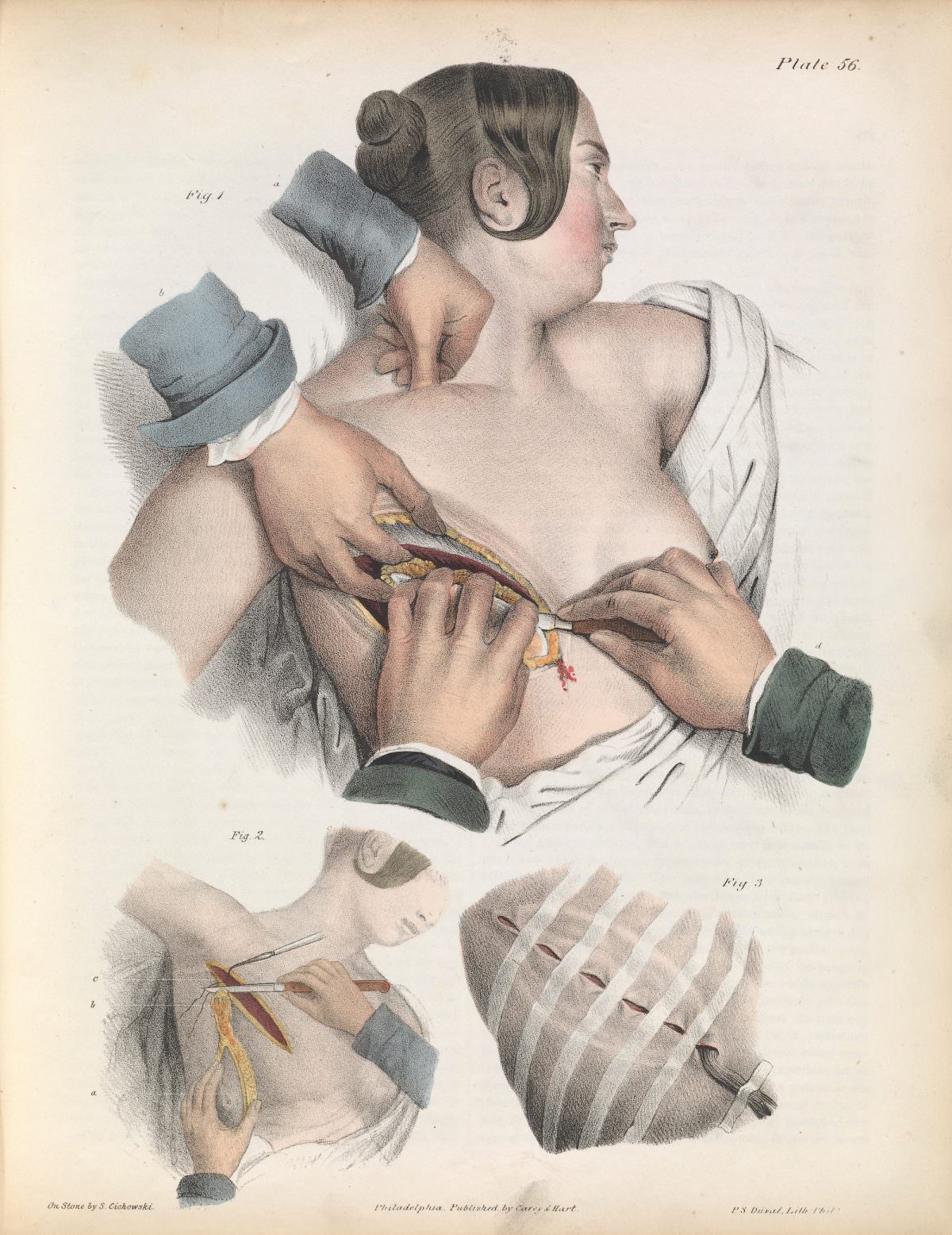
Plate LVI from *Iconografia d’anatomia chirurgica e di medicina operatoria* confronts the viewer with the practical theatre of 19th-century surgery: a woman reclines as gloved hands hold tissue aside and guide a blade through the breast. The patient’s turned head and exposed shoulder create a portrait-like calm in sharp contrast to the incision, where color and careful shading emphasize anatomy, fat, and fascia with textbook clarity.
Rather than offering a single scene, the illustration is arranged as a small sequence—an operative moment above, a secondary view of the procedure below, and a separate drawing of the finished bandaging at the side. Those numbered figures and precise cuts read like instructions for students, reflecting how surgical knowledge traveled through atlases long before photography could reliably document an operation.
For readers interested in medical history, surgical illustration, and the evolution of breast surgery, this artwork is a compelling reminder of the era’s mixture of confidence and risk. It also serves as a visual record of technique: how assistants’ hands were positioned, how tissues were separated, and how dressings were applied to secure healing. As a historical image for a WordPress post, it offers rich detail for discussions of anatomy, operative medicine, and the ethics of representing the body in 19th-century scientific publishing.