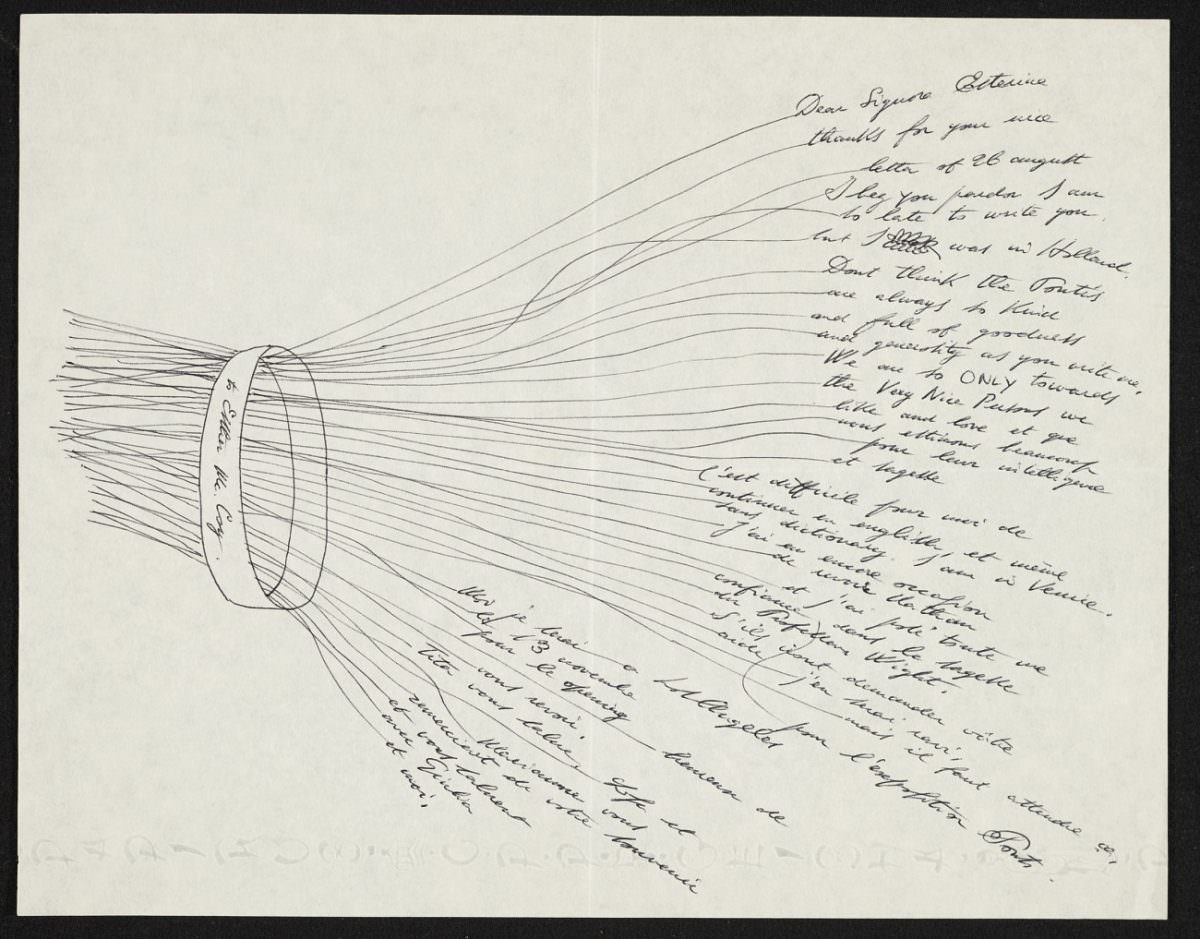
Across a clean sheet, a bold oval ring sits at the left like a seal or portal, sending out dozens of fine, radiating lines that sweep the eye toward a dense block of cursive at the upper right. The composition feels both architectural and intimate—part diagram, part letter—where pen strokes behave like beams, currents, or threads connecting two points. Even without color, the page has a kinetic elegance, as if the message itself were drawn into motion.
At the heart of the work is handwriting addressed as correspondence, with the title identifying it as “Gio Ponti to Esther McCoy, 1978.” The text is not merely informational; it becomes a visual element, clustered and angled, while the lines act like vectors guiding attention across the page. What reads as a personal note also functions as an artwork on paper, blending graphic design, calligraphy, and playful abstraction into a single, conversation-like surface.
Between sender and recipient, the piece suggests a wider network of ideas—design thinking rendered as a lived exchange rather than a finished product. For readers interested in Gio Ponti, Esther McCoy, modern design history, or archival letters as art, this historical image offers a striking example of how communication can become composition. It invites close looking: follow the arcs, linger over the pen pressure, and consider how a simple letter can hold the energy of a creative relationship.