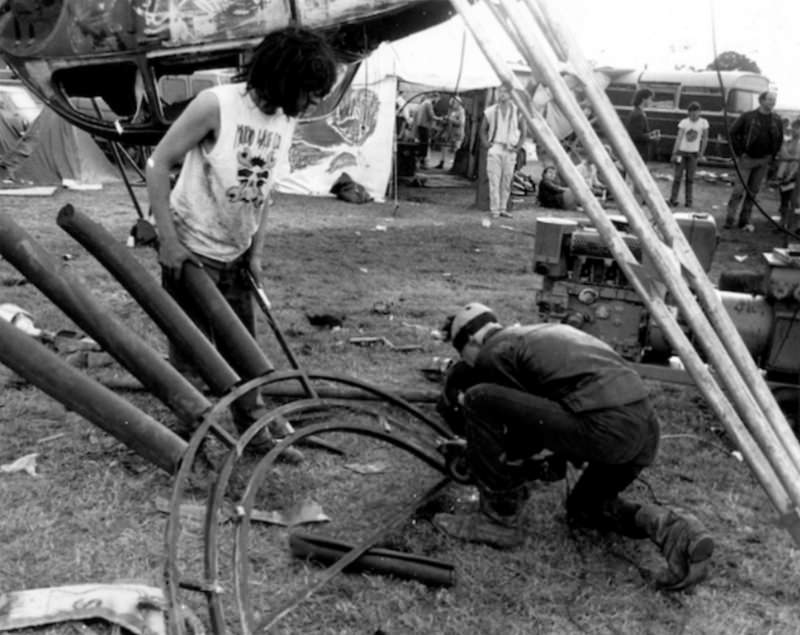
Welders crouch in the mud beside a rough scaffold of pipes and curved metal ribs, turning scrap into something that feels halfway between a machine and a monster. In the foreground, cut tubing and bent hoops suggest the skeleton of a new creature, while behind them tents, cables, and onlookers hint at a temporary camp where art and improvisation blur together. The scene fits the spirit of the Mutoid Waste Company: post-industrial creativity built from whatever could be rescued, bolted, or burned into shape.
Noise, heat, and the smell of hot steel seem to radiate from the photograph, even in stillness. One figure leans over a cluster of thick pipes, another kneels close to the work, focused on joining pieces that once belonged to scrapped cars and discarded machinery. Rather than a pristine studio, the setting looks like an outdoor workshop—part festival, part scrapyard—where performance and fabrication happen in the same breath.
Stories like this help explain why 1980s scrap metal art still fascinates collectors, photographers, and fans of underground culture. The “bizarre artworks” weren’t polished showpieces so much as living experiments: automotive leftovers reshaped into kinetic sculptures and industrial assemblages that challenge the idea of waste. For anyone searching for Mutoid Waste Company car-scrap sculptures, post-apocalyptic art aesthetics, or 1980s alternative art scenes, this image offers a gritty, ground-level view of creation in progress.