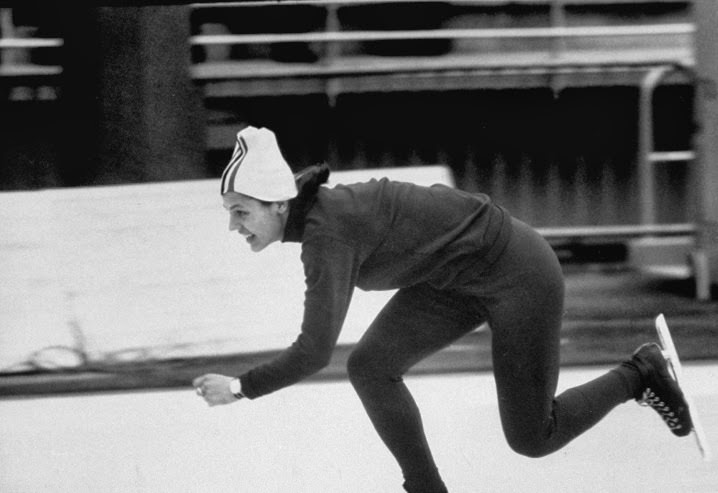
Leaning low over the ice, Lyudmila Titova drives forward with a sprinter’s intensity, her shoulders tucked and her stride stretched long as the rink blurs behind her. The knit cap and streamlined racing suit underline the practical aesthetics of mid-century speed skating, when warmth and aerodynamics had to be balanced without today’s high-tech materials. In the background, the stadium’s railings and shadows hint at a larger arena just beyond the frame, keeping the focus squarely on the athlete’s form.
Grenoble’s 1968 Winter Olympics were a showcase for speed skating’s demands: raw power, razor control, and the mental discipline to maintain pace lap after lap. Titova, remembered as a three-time Olympic medalist, represents that era’s hard-earned excellence—where medals were often decided by fractions of a second and flawless technique. The photograph freezes a moment of acceleration, the kind that spectators feel as much as they see when a skater surges out of a turn.
For readers searching Olympic history, women’s speed skating, or archival sports photography, this post offers a vivid glimpse into the competitive atmosphere surrounding the Grenoble Games. Details like her forward-leaning posture and the crisp line of her skate blades convey the biomechanics that made champions, long before modern training analytics entered the sport. It’s a reminder that behind every podium finish stands countless hours of repetition—translated here into one determined push across the ice.