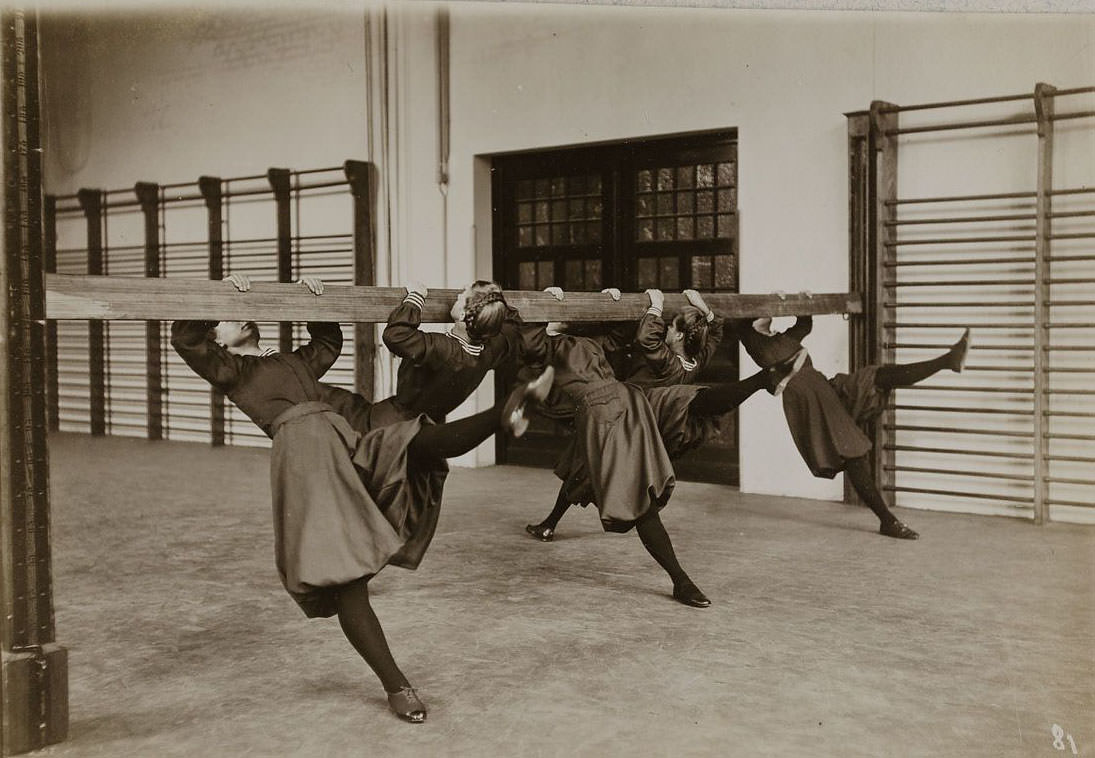
Arms stretched high along a sturdy wooden beam, a line of German women lean back in unison while lifting one leg into a crisp, controlled extension. The setting looks like a dedicated gymnasium, complete with wall bars and a wide open floor that gives the movement room to breathe. Their matching outfits and synchronized form emphasize discipline and group training—hallmarks of early 1900s physical culture.
Swedish gymnastics, known for its structured, health-focused exercises, spread across Europe as educators and reformers promoted posture, strength, and coordinated movement. In Heinrich, Germany, the practice appears here as both exercise and instruction, with the long beam acting as a shared support for balance and alignment. The pose captured mid-routine highlights precision over spectacle, suggesting a methodical lesson rather than a performance.
Details like the barred apparatus, the orderly spacing, and the confident, athletic stances make this photograph a strong window into women’s sports history. It also hints at changing attitudes toward female fitness in the early twentieth century, when organized training began to claim space in schools and clubs. For readers searching for “German women gymnastics,” “Swedish gymnastics,” or “1900s sports,” this image offers a vivid, grounded glimpse of how movement culture looked and felt in its everyday practice.