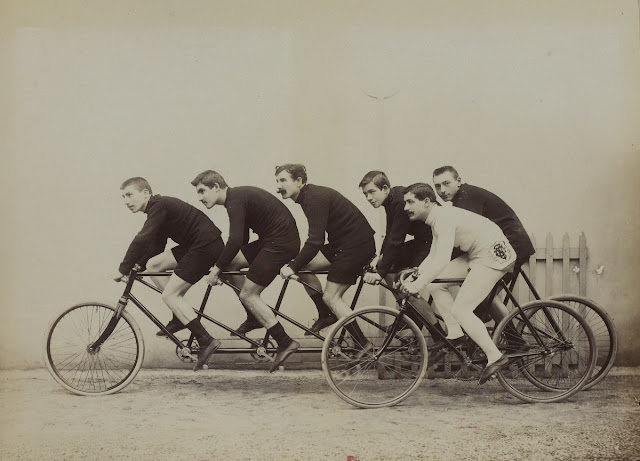
A line of riders leans forward in practiced unison, their bodies stacked along an elongated tandem bicycle as if the machine itself were a small team. The studio-like backdrop and sparse fence keep attention on the mechanics of the sport: narrow tires, spidery wheels, and the rigid frame built for speed rather than comfort. Even without modern helmets or padded kits, the cyclists project the seriousness of competitive racing, turning a novelty vehicle into an athletic instrument.
Jules Beau’s 19th-century sports photography helps explain how tandem cycling moved from curiosity to organized spectacle, where synchronization mattered as much as strength. The coordinated posture hints at shared cadence and trust—one misstep would ripple down the line—while the plain, fitted uniforms suggest a club culture already forming around rules and performance. Details like the riders’ focused gazes and the clean geometry of the bike’s frame make the scene feel both experimental and surprisingly professional.
For readers searching for early cycling history, vintage sports photos, or the origins of tandem bicycle racing, this image offers a crisp window into a formative moment. It invites questions about training, equipment design, and how photographers staged athletic subjects to communicate speed and modernity in the late 1800s. As part of Beau’s broader body of work, the photograph stands as a visual record of endurance, teamwork, and the evolving identity of cycling as a competitive sport.