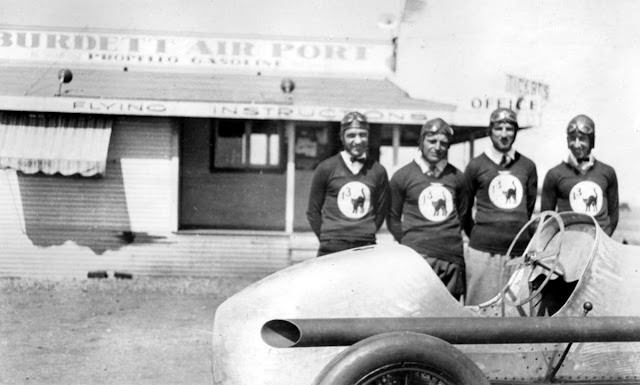
Beneath the bold “BURDETT AIR PORT” sign, a line of aviators poses in matching “Black Cat” sweaters, their insignia centered like a badge of belonging. The building behind them reads as both office and workshop—part storefront, part hangar culture—while the sunlit siding and shaded doorway hint at a busy airfield routine. Even without a captioned date, the leather helmets and practical knitwear place the scene firmly in the era when flight still carried the thrill of experiment and spectacle.
In the foreground, the rounded nose and wheel of a small aircraft intrude into the frame, reminding us that these men weren’t merely dressed for a photograph—they were dressed for risk. The “Flying Instruction” lettering visible on the façade suggests a place where training and performance overlapped, where pilots learned precision before turning it into entertainment. Matching team apparel also signals early aviation’s crossover with sports culture: identity, branding, and crowd appeal stitched into wool.
Stories of the “Flying Black Cats” evoke the barnstorming tradition, when aerial stunts drew audiences eager to see skill pushed to its limit. This photo, set outside the Burdett Air Port office, offers a grounded counterpoint to those high-altitude feats—an everyday moment of camaraderie, preparation, and pride. For readers searching aviation history, barnstorming teams, or the Black Cat sweaters and insignia, it’s a striking glimpse into how early pilots built both a profession and a legend.