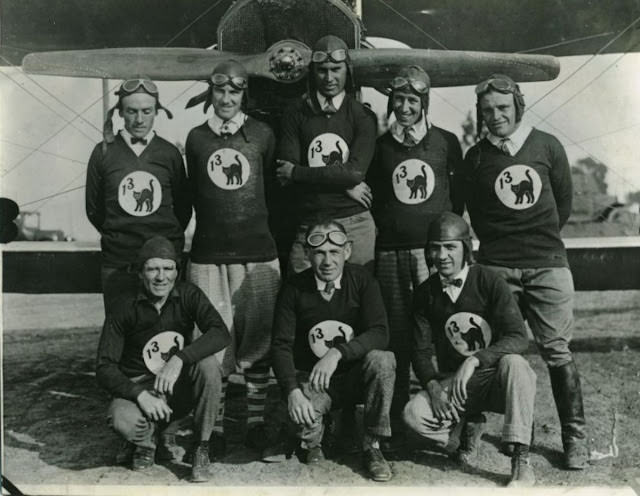
Leather helmets and wind-worn goggles set the tone as a group of aviators pose confidently in front of their aircraft, each wearing a matching sweater emblazoned with a bold “13” and a black cat emblem. The title, “The 13 Flying Black Cats,” isn’t just a catchy nickname—it reads like a challenge to superstition, turning an unlucky number into a team identity meant to be seen from the ground and remembered in print. Framed tightly against the plane’s broad wing and struts, the portrait emphasizes camaraderie and the rugged, hands-on world of early flight.
The men’s uniforms feel practical rather than theatrical, suggesting performers who earned trust through repetition, precision, and nerve. With the aircraft looming behind them, the photo hints at the kind of aerial stunt work and barnstorming culture often associated with the 1920s, when pilots became public celebrities and air shows drew crowds hungry for speed and spectacle. That simple insignia—cat silhouette inside a circle—functions like early aviation branding, equal parts mascot, signature, and warning that these flyers were comfortable living on the edge.
For readers exploring aviation history, daredevil pilots, and classic air show photography, this image offers a vivid doorway into a time when flight still carried the aura of experiment and risk. The “Flying Black Cats” name invites questions about team routines, publicity, and how these performers marketed fearlessness in an era before modern safety standards. As a historical photo for a WordPress post, it’s rich with searchable themes—1920s aviation, barnstormers, aerial stunts, pilot gear, and early aircraft culture—while leaving just enough mystery to keep you looking closer.