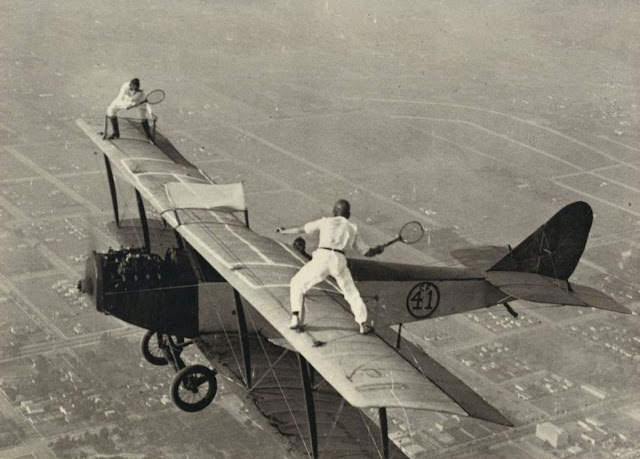
Balanced high above the ground, Ivan “Bugs” Unger and Gladys Roy turn the upper wing of a Curtiss Jenny into a tennis court, rackets raised as if the sky were just another sporting venue. A small net stretches across the wing, and the players’ stances—wide-footed, braced against the airflow—hint at the constant push and pull of wind at altitude. Below them, the landscape fades into a soft grid of fields and roads, emphasizing how far these aerial performers were willing to take a simple game.
Stunt flying in the 1920s thrived on this kind of theatrical daredevilry, when barnstorming teams drew crowds by mixing aviation, athletics, and showmanship. The “Flying Black Cats” were among the best known of these exhibition troupes, famous for wing-walking and other carefully rehearsed feats that looked impossibly casual from the ground. In an era when planes were still new to many spectators, turning flight into entertainment helped sell the romance—and the perceived mastery—of the modern air age.
Details of the aircraft stand out for aviation enthusiasts and history readers alike: the Curtiss Jenny’s stacked wings and open-air design create the perfect stage for a stunt that relies on visibility as much as skill. The bold marking on the fuselage, the minimalist gear, and the very idea of a net anchored to fabric-covered wings all speak to a time when performance and risk were woven into early flight culture. For anyone searching aviation history, barnstorming legends, or Gladys Roy and Ivan “Bugs” Unger, this photograph remains a vivid reminder of how spectacle once rode on the back of a biplane.