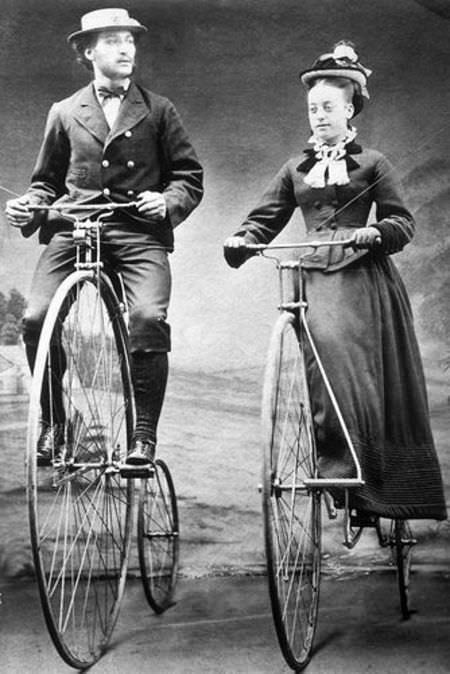
Poised on towering front wheels, a well-dressed pair balances elegance and daring in a studio setting that feels both theatrical and intimate. The man’s confident seat high above the ground contrasts with the woman’s composed stance beside her own machine, their formal clothing and hats underscoring how cycling quickly became a social statement as much as a mode of travel. Fine spokes, slim tires, and upright handlebars draw the eye to the ingenious simplicity of early bicycle engineering.
Penny-farthings demanded skill: the rider’s position, the direct-drive pedal on the oversized wheel, and the absence of modern brakes all shaped a very particular kind of speed—and risk. Yet photographs like this also hint at the thrill of new mobility, when invention was not confined to workshops but lived out in public fashion, posture, and performance. Even without a named place or date, the scene evokes the late 19th-century appetite for mechanical progress and spectacle.
For collectors, researchers, and cycling enthusiasts, these timeless vintage cycling photographs offer more than nostalgia; they preserve the culture that grew around a transformative invention. Details in attire and machine design help trace how bicycles evolved from precarious high-wheelers into the safer forms that followed, and how riders presented themselves in that transition. Add this piece to your exploration of antique bicycles, penny-farthing history, and the early era of cycling as both pastime and innovation.