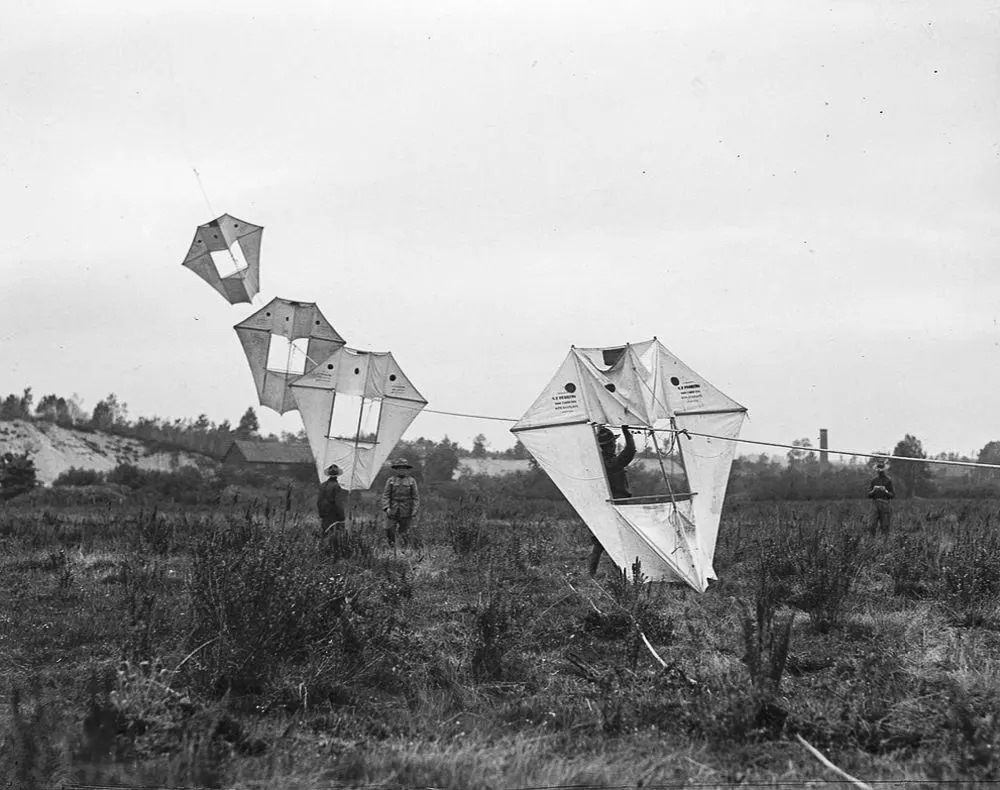
Across a rough field, a cluster of boxy kites strains at their lines while onlookers stand back, watching the wind do the heavy lifting. One of the largest kites carries a small suspended frame—part basket, part rigging—hinting at the bold purpose behind these designs. Before reconnaissance planes became routine, engineers and military planners experimented with man-lifting kites as a practical way to raise an observer above the ground and extend the horizon.
What makes the scene so striking is its mix of simplicity and daring: fabric, spars, and taut ropes forming a temporary aerial system built for stability rather than grace. Multiple kites appear to work in tandem, a common approach for generating more lift and keeping the load steady when gusts shift. In an era hungry for new inventions, these kite trains promised quick deployment, a relatively light footprint, and a vantage point that could transform scouting, signaling, and battlefield awareness.
The photo also captures the transitional moment between older observation methods and the coming age of powered flight—an inventive bridge that’s easy to forget. Man-lifting kites weren’t toys; they were reconnaissance technology, tested and refined like any other serious tool of war and exploration. If you’re fascinated by early aviation history, military innovation, and the ingenious precursors to modern aerial surveillance, this post dives into how these remarkable kites worked and why they mattered.