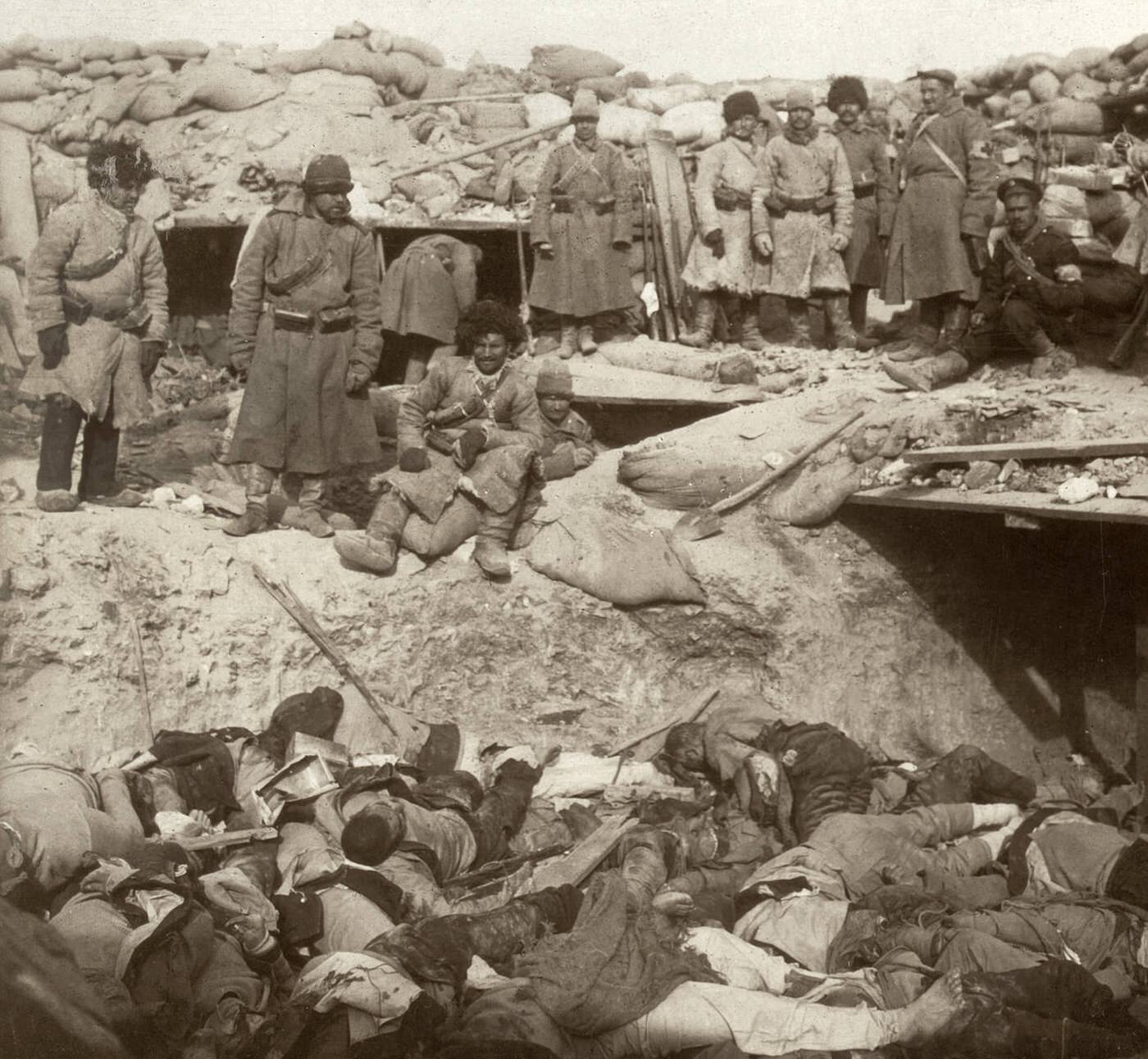
Along the packed earthworks of a Russian fort at Port Arthur, the camera lingers on a grim contrast: a line of soldiers standing amid sandbags and timbers, and below them a trench choked with bodies. The fortification’s rough layers—stacked sacks, dugouts cut into the slope, scattered boards—suggest a position built to endure prolonged bombardment and assault. Nothing in the scene is staged for comfort; it reads as battlefield evidence, with the human cost placed bluntly in the foreground.
Taken in 1905 during the fighting around Port Arthur in China, the photograph points to the brutal mechanics of siege warfare in the Russo-Japanese War. The trench functions both as defensive architecture and as an impromptu grave, hinting at close-quarters attacks where men fell in confined spaces and were left where they landed. For readers searching military history imagery, it offers a stark look at early 20th-century fort combat—earth, sandbags, and attrition—before later wars made such scenes tragically familiar.
What makes the image linger is the uneasy stillness: the upright figures above, the disorder below, and the silence implied between them. It invites reflection on how war photography has been used to document victory, prove resistance, or simply record what words struggle to convey. As a historical photo of Port Arthur, it stands as a severe reminder that behind strategy and empires were trenches like this—tight, muddy corridors where the outcome was measured in bodies.