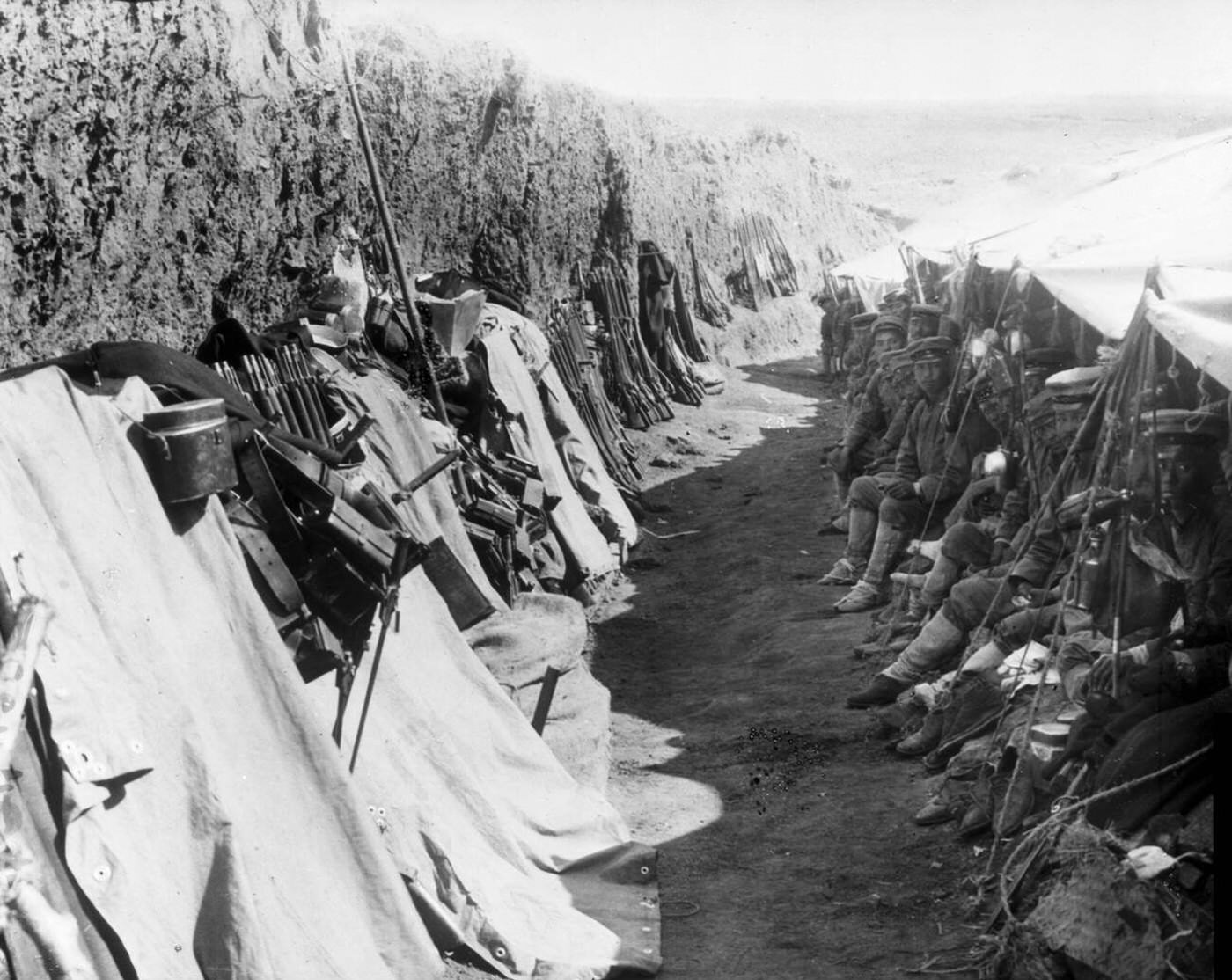
Along the earthen wall of a narrow trench, rifles and gear are stacked in dense rows, their bayonets and long barrels forming a jagged fence of steel. Canvas sheets and makeshift covers drape over the dugout edges, softening the harsh lines of packed soil and creating small pockets of shelter. The perspective leads the eye down the passageway, emphasizing how cramped and improvised life at the front could be during the siege fighting.
On the right, Japanese soldiers sit shoulder to shoulder beneath the shade, their uniforms dusted with the grime of sustained campaigning. Some look toward the camera while others seem lost in thought, embodying the quiet intervals between alarms—moments when exhaustion, routine, and vigilance coexist. The trench itself reads like a working corridor: a place to rest, store weapons, and wait, all within a few feet of danger.
Set at Port Arthur, China, in 1905, the scene offers a grounded glimpse into the Russo-Japanese War beyond maps and commanders’ reports. Rather than dramatic charges, it highlights logistics and endurance—the careful arrangement of arms, the sheltering cloth, the human need to sit down and breathe. For readers exploring early 20th-century warfare, siege tactics, and military history photography, this image underscores how modern conflict was increasingly shaped by trenches, fortifications, and long days spent underground.