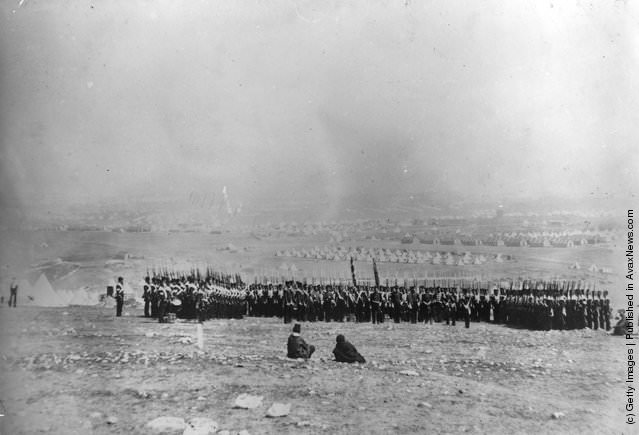
Across a bleak, open slope, ranks of infantry stretch in long, dark lines, their bayonets forming a jagged horizon against the haze of the Crimean War. The title identifies Colonel Shadforth with the 57th Regiment, and the scene reads as a moment of ordered discipline set amid a vast encampment, with tents and scattered figures receding into the distance. Smoke or mist hangs over the background, softening the landscape while emphasizing the scale of a wartime staging ground.
The 57th Regiment’s formation—tight files, steady spacing, and a clear sense of command—speaks to the routines that underpinned nineteenth-century campaigning: parade-ground precision carried into hostile terrain. Soldiers appear assembled for inspection, drill, or preparation, while the camp behind them hints at the everyday logistics of the Crimea: shelter, supplies, and the constant movement of men and matériel. Even without close-up faces, the photograph conveys a collective identity, the regiment presented as a single, disciplined body.
War and military history often turns on famous battles, yet images like this bring attention to the quieter, essential moments that made those events possible. For readers exploring Crimean War photographs, British Army regiments, and the lived reality of mid-1850s campaigning, this view offers both atmosphere and context—order carved into a harsh landscape. It’s a stark reminder that leadership and endurance were tested not only in combat, but also in the long hours of waiting, marching, and maintaining formation under uncertain skies.