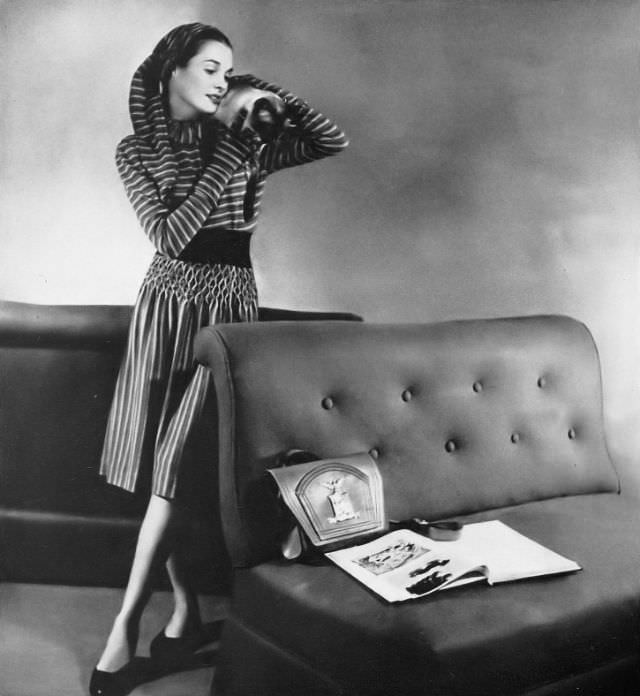
Leaning against a tufted sofa, a poised fashion model strikes a thoughtful, almost cinematic pose, one arm lifted to frame her face as she gazes off to the side. The setting is spare but telling: a studio-like interior with smooth upholstery and an open magazine draped across the cushion, suggesting the world of editorial styling where everyday objects become part of the narrative. The lighting is soft and controlled, emphasizing clean lines and a polished 1940s mood without distracting from the clothes.
Her two-piece ensemble, credited to Tina Leser for Harper’s Bazaar in 1946, balances comfort and elegance in a way that feels distinctly postwar. A fitted, striped top—read as jersey—hugs the torso and sleeves, while a dark waistband transitions into a fuller skirt with vertical striping and textured smocking at the hip. Even in monochrome, the patterning reads boldly; the title’s blue, pink, and white palette underscores how color and rhythm were used to enliven a streamlined silhouette.
What makes the photograph linger is its sense of modernity: relaxed, wearable separates presented with the refinement of high fashion. Tina Leser’s design language merges traditional femininity—nipped waist, graceful skirt—with contemporary ease, echoing the decade’s shift toward practical glamour. For historians of mid-century style and collectors of Harper’s Bazaar imagery, the scene offers a crisp snapshot of 1946 fashion culture, where graphic stripes, jersey fabrication, and editorial staging signaled a confident new direction.