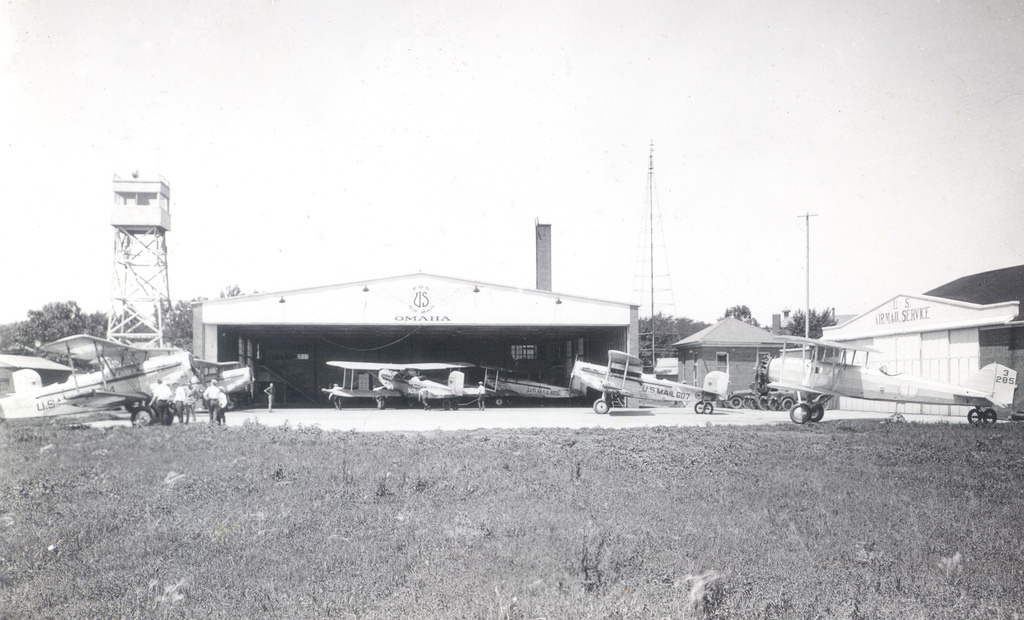
Across a grassy field in Omaha, Nebraska, a row of early airmail planes waits in front of a busy hangar marked for service, their wings and bracing wires forming a crisp lattice against the bright sky. The scene feels halfway between barnstorming spectacle and industrial routine: open-cockpit aircraft lined up like delivery trucks, ready to trade dirt runways for long, uncertain routes. In 1924, the airmail system was still proving that speed and regularity could conquer distance, and images like this one show how that promise looked on the ground.
Near the hangar doors, a small cluster of people stands beside the aircraft, suggesting the practical teamwork behind every flight—mechanics, handlers, and airmen moving around machines that demanded constant attention. A watchtower rises at the left, while radio masts and utility poles hint at the communications that were transforming aviation from daring experiment into dependable service. Even without motion, the photograph carries the feel of a working station: equipment staged, planes positioned, and the next dispatch implied.
Omaha’s airmail field appears here as a link in a larger chain of American innovation, where inventions were measured not only in patents but in punctual departures and sorted sacks of letters. For historians of early aviation, postal history, and Nebraska heritage, this photograph offers a grounded look at the infrastructure that made air travel practical before sleek terminals and pressurized cabins. It’s a reminder that modern connectivity began with fabric-and-wood aircraft, open skies, and the everyday discipline of getting the mail through.