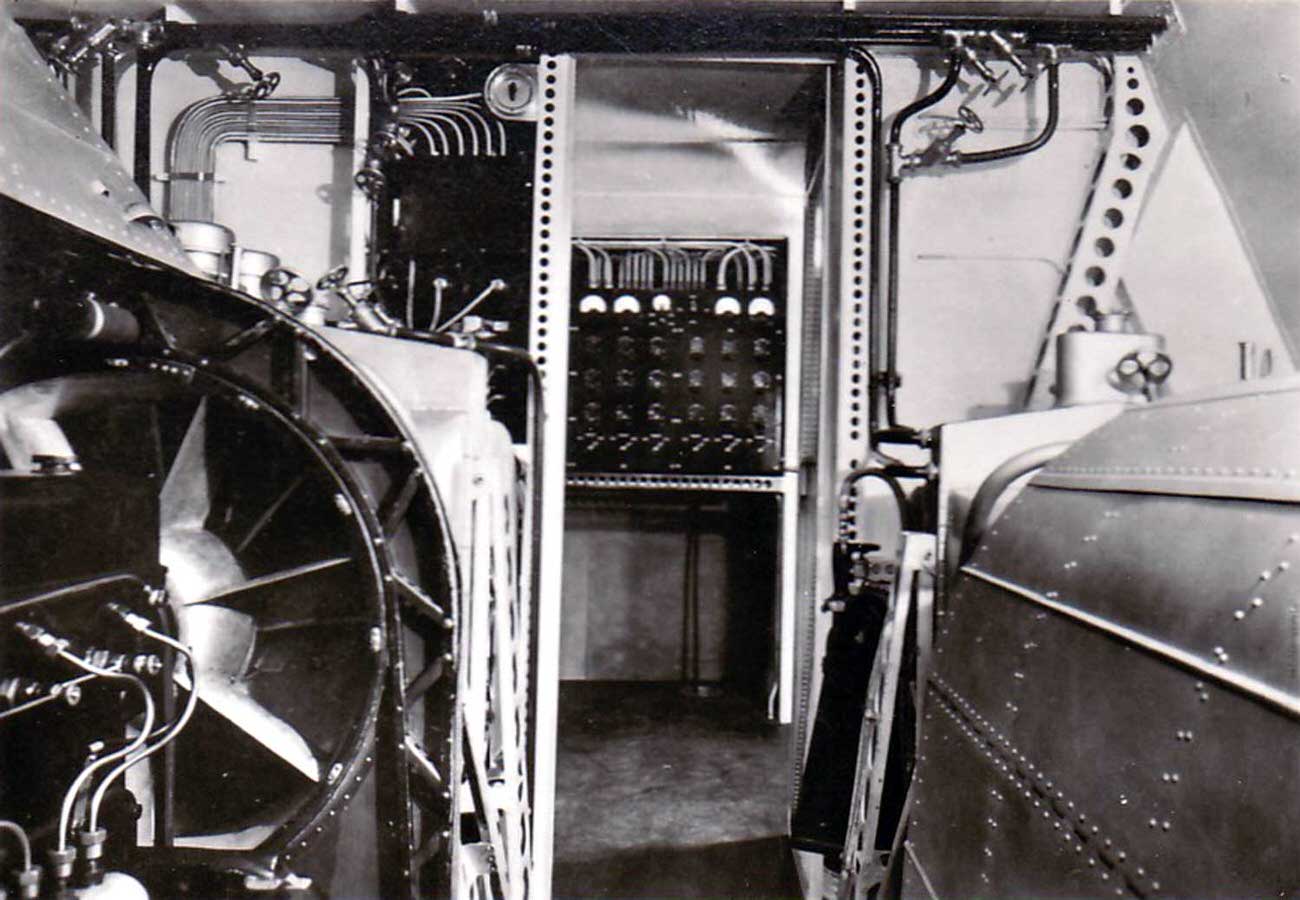
Step into the electrical room on the Hindenburg and the romance of airship travel immediately gives way to hard-edged engineering. Narrow space is packed with riveted metal housings, thick cable runs, and a central switchboard-like panel that hints at the careful routing of power and signals. It’s a behind-the-scenes view that reminds us how much of the famous zeppelin’s story was written in machinery rather than in passenger lounges.
On the left, a large fan or motor assembly dominates the frame, its blades and fittings suggesting forced ventilation or auxiliary drive equipment, while the right side is lined with another substantial enclosure, bolted and sealed for safety. Overhead, bundled wiring and neatly bent conduits trace purposeful paths, turning the room into a kind of industrial map. Details like these make the photo invaluable for anyone interested in early aviation technology, historical electrical systems, or the practical realities of running a giant lighter-than-air craft.
For readers following “Inventions,” this image is a compact lesson in how innovation looked in everyday operation: not sleek, but disciplined, redundant, and built for inspection and repair. The Hindenburg is often remembered for spectacle and tragedy, yet scenes like this underline the era’s confidence in electrification and control—power distributed through panels, valves, and cabling tucked into tight compartments. As a piece of airship history, the photograph invites closer reading, from the texture of rivets to the geometry of wiring that kept the ship’s systems alive.