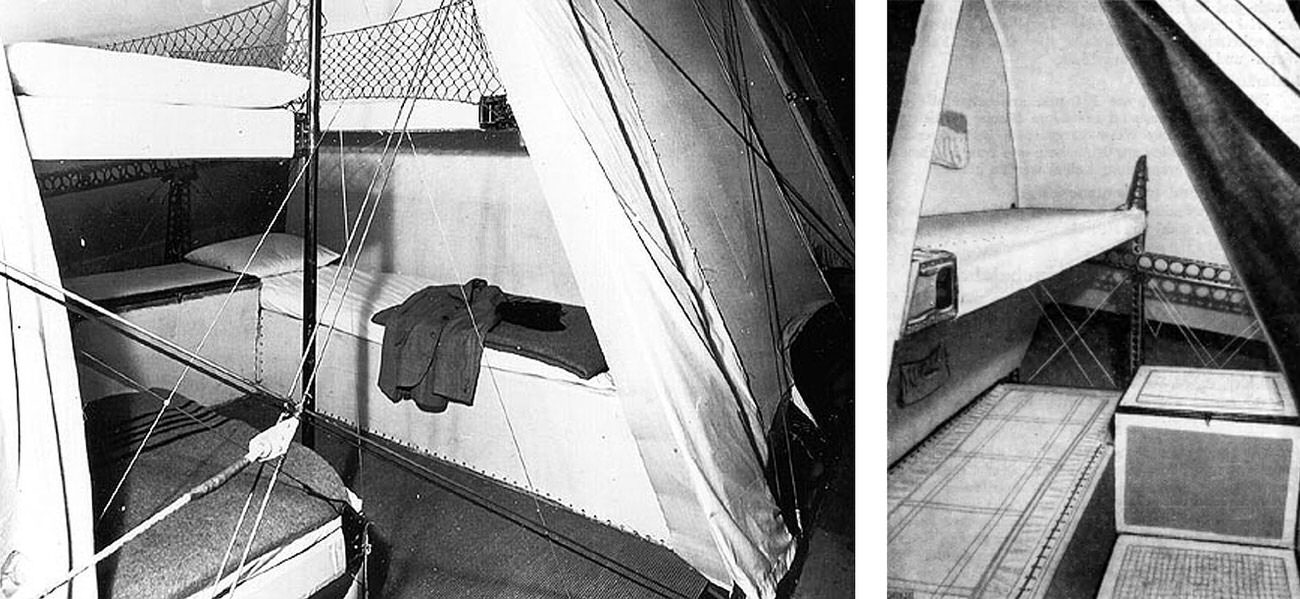
Tucked along the Hindenburg’s keel, these crew bunks reveal the everyday, workmanlike side of a machine often remembered for spectacle. Narrow stacked berths, safety netting, and tightly stretched fabric partitions turn an immense airship into a series of compact living niches, where rest had to fit around the demands of flight. The casual placement of clothing on a mattress hints at a space used in quick shifts rather than leisurely comfort.
Details in the photograph underline how airship interiors balanced lightness with practicality: thin framing, riveted panels, and simple fittings that keep weight down while still providing order. The aisle-like floor and close quarters suggest a dormitory designed for efficiency, not luxury, with personal storage reduced to the basics. Even the curtain-like divider feels less like décor and more like an adaptable solution for privacy inside a rigid, engineered environment.
Looking closely, the image becomes a small lesson in the history of inventions—how pioneering transportation required not just dramatic exteriors, but also functional human spaces embedded within the structure. For readers searching for Hindenburg interior photos, airship crew quarters, or early aviation living conditions, this view offers a grounded perspective on life aboard a giant zeppelin. It’s a reminder that technological ambition was carried forward by people sleeping, waking, and working in places built to the tightest margins.