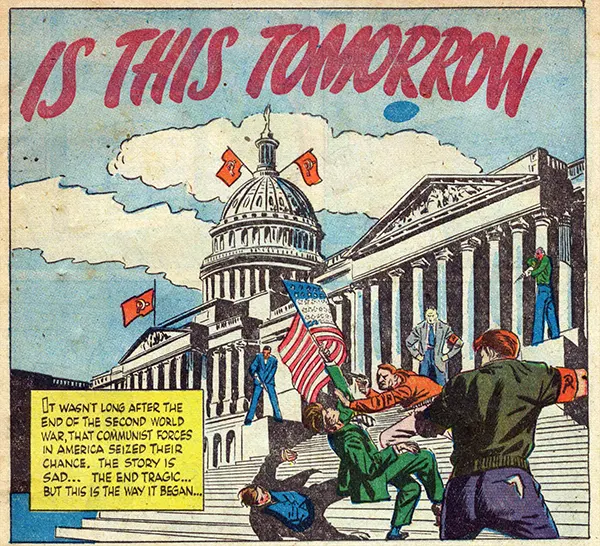
Bold lettering sprawls across the top—“IS THIS TOMORROW”—setting a breathless tone that matches the cover’s sense of emergency. On the steps of a grand domed government building, chaos erupts: bodies tumble, a figure in orange is yanked forward, and a man clutches an American flag amid the confusion. Red banners with hammer-and-sickle symbols flutter over the scene, turning a recognizable civic backdrop into a stage for political nightmare.
A caption box at lower left frames the story as a warning, invoking the aftermath of the Second World War and imagining “communist forces” seizing control in America. The artwork leans into mid-century propaganda aesthetics—high-contrast ink lines, theatrical poses, and simplified heroes and villains—designed to be read at a glance on a newsstand. It’s not subtle history; it’s history filtered through fear, selling the Cold War as a personal, street-level threat.
For readers interested in vintage comics, anti-communist media, and postwar American culture, this cover is a vivid artifact of how ideology was packaged as popular entertainment. The Capitol-like architecture, the violent struggle on the steps, and the stark symbolism all work together to dramatize the “Red Scare” anxieties that ran through politics, schools, workplaces, and pulp publishing. Seen today, “Is This Tomorrow: America Under Communism!” offers a sharp reminder of how quickly public imagination can be mobilized by images—and how comics helped shape that imagination.