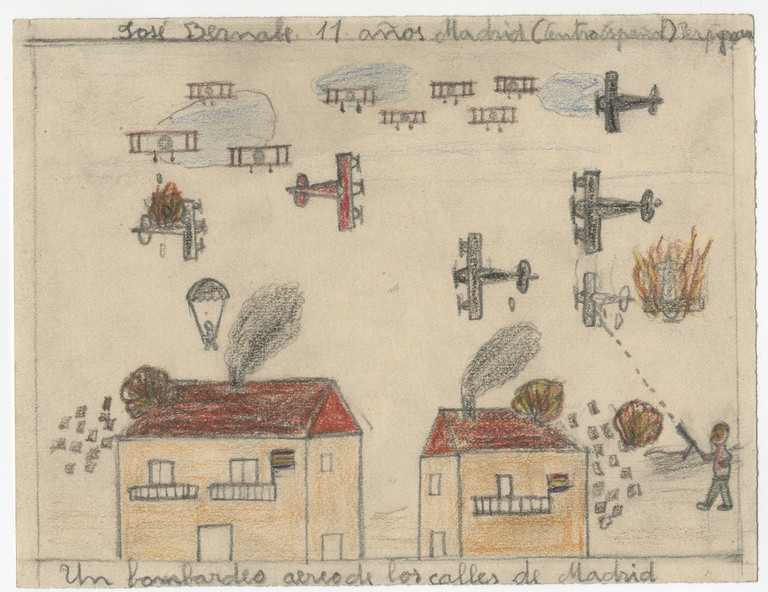
José Bernabe’s drawing, identified in the title as made at age 11 in Perpignan’s Spanish Center, turns the terror of Madrid under aerial attack into a child’s blunt, unforgettable language. Across a pale sky, airplanes crowd the page in rough formation while small parachutes drift downward, and the scene below is anchored by two simple houses with red roofs. Smoke rises in dark plumes, flames flare at the edges, and scattered marks suggest debris or shrapnel shaking the streets.
What makes this historical image so affecting is the contrast between its schoolroom clarity and the violence it describes: neat balconies, rectangular windows, and tidy outlines sit beside explosions and falling bombs. A small figure at the right edge seems to gesture toward the chaos, turning the picture into a witness statement as much as an artwork. The composition reads like a memory organized for survival—sky, planes, impacts, then the home front, all rendered with the limited tools of pencil and colored crayon.
For readers searching for Spanish Civil War-era visual culture, refugee children’s art, or primary-source perspectives on the bombing of Madrid, this piece offers a powerful entry point. It belongs to the broader story of displacement and documentation, where drawings made far from the front carried the sounds and sights of war into exile. Seen today, it asks us to look beyond strategy and headlines and to reckon with how conflict imprints itself on childhood, line by line.