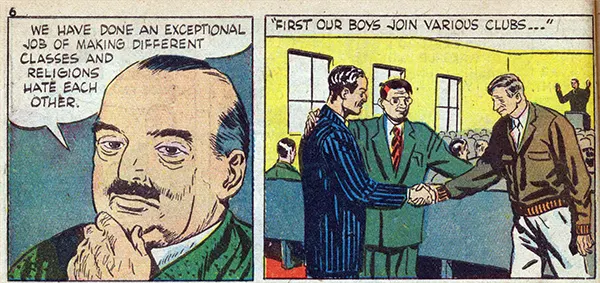
Propaganda rarely whispers, and the panels from *Is This Tomorrow: America Under Communism!* lean into that loud, urgent tone that defined so much Cold War-era popular culture. The artwork frames its warning through everyday scenes and plainspoken captions, turning fear into a story that feels immediate and personal. For readers and collectors today, the comic’s bold lines and simplified moral contrasts offer a vivid window into how political anxiety was packaged for mass consumption.
In the excerpt shown here, a stern, mustached figure speaks in a confessional bubble about setting “classes and religions” against one another, while the adjoining scene shifts to a handshake in a room that resembles a meeting hall. Suits, uniforms, and a watchful background crowd create the sense of organized recruitment, with the narration suggesting a step-by-step method rather than a distant conspiracy. That visual pairing—monologue and social interaction—turns ideology into theater, implying that friendly introductions and civic clubs are the front door to something darker.
What makes this 1947 anti-communist comic art so searchable and shareable now is how clearly it illustrates America’s postwar fears: infiltration, division, and the fragility of community trust. The colors, the facial expressions, and the stark lettering belong to a moment when comics were treated as both entertainment and weaponized messaging. As a historical artifact, it helps explain the emotional texture of early Cold War America, where political debates spilled into classrooms, churches, workplaces—and even the panels of a cheaply printed comic book.