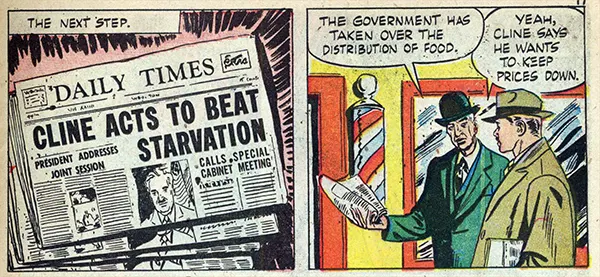
A bold newspaper splash—“DAILY TIMES” with the ominous headline “CLINE ACTS TO BEAT STARVATION”—sets the tone for this piece of Cold War-era comic art, where alarm is packaged as front-page certainty. The panel’s heavy inks and urgent typography sell a crisis narrative at a glance, echoing how mass media and popular culture fed public anxieties about scarcity, control, and the future. For readers interested in 1947 propaganda aesthetics, the composition is a lesson in how fear was made legible and shareable.
Inside the next scene, two men in hats and coats talk beneath bright, simplified blocks of color, while dialogue declares that “the government has taken over the distribution of food.” The exchange frames everyday necessities as a political battleground, pushing the idea that centralized control—presented here as a step toward communism—would reach straight into the grocery line and the dinner table. As a visual artifact, it’s a vivid example of how comic books and illustrated narratives translated complex ideological tensions into quick, conversational drama.
Between the stark headline and the street-level conversation, the artwork captures a particular style of mid-century warning tale: direct, dramatic, and designed for fast emotional impact. The title “Is This Tomorrow: America Under Communism!” signals the larger theme, and these panels underline the message by pairing government action with the specter of starvation and price control. For collectors, historians, and SEO searches focused on anti-communist comics, Cold War fear culture, and 1940s American political art, this image offers a compact window into how propaganda could look and read in popular print.