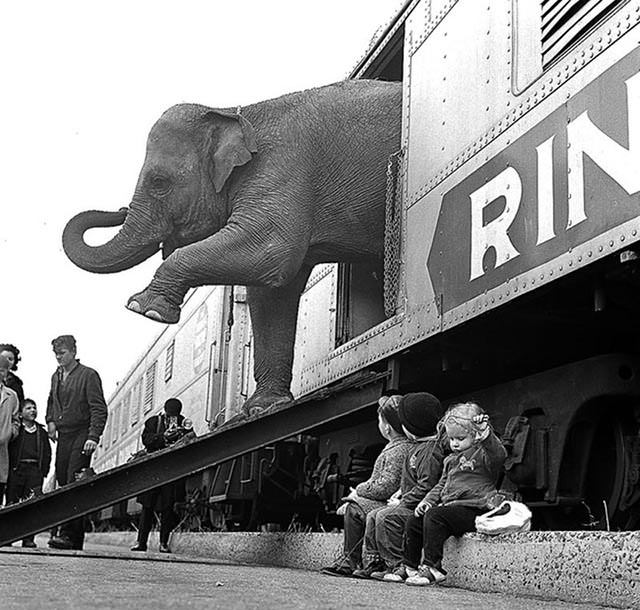
An elephant leans out of a Ringling Brothers Circus train car, curling its trunk as it tests the ramp below, turning a routine unloading into street-corner theater. The bold “RING” lettering on the railcar side anchors the scene in circus branding, while the animal’s massive shoulder and careful, lifted foreleg emphasize both weight and grace. In 1963, this kind of rail-borne spectacle was part of how the big shows moved—steel, rivets, and muscle bringing the circus from town to town.
Along the platform edge, bundled children sit close enough to feel the moment, their faces angled up with a mix of curiosity and caution. Adults linger to the left, watching like chaperones and bystanders at once, as if the boundary between everyday travel and performance has briefly dissolved. The low ramp, the open car door, and the elephant’s deliberate posture spotlight the logistics behind the magic: getting animals safely from train to ground.
Viewed today, the photograph reads as a vivid slice of mid-century circus history and a reminder of how intimately audiences once encountered traveling entertainment. It’s funny in the best way—an elephant half-emerging like an oversized commuter—yet it also documents the machinery and public choreography of the Ringling Brothers Circus era. For anyone searching vintage circus photos, Ringling Brothers train images, or 1960s Americana, this scene delivers a memorable, unmistakable moment.