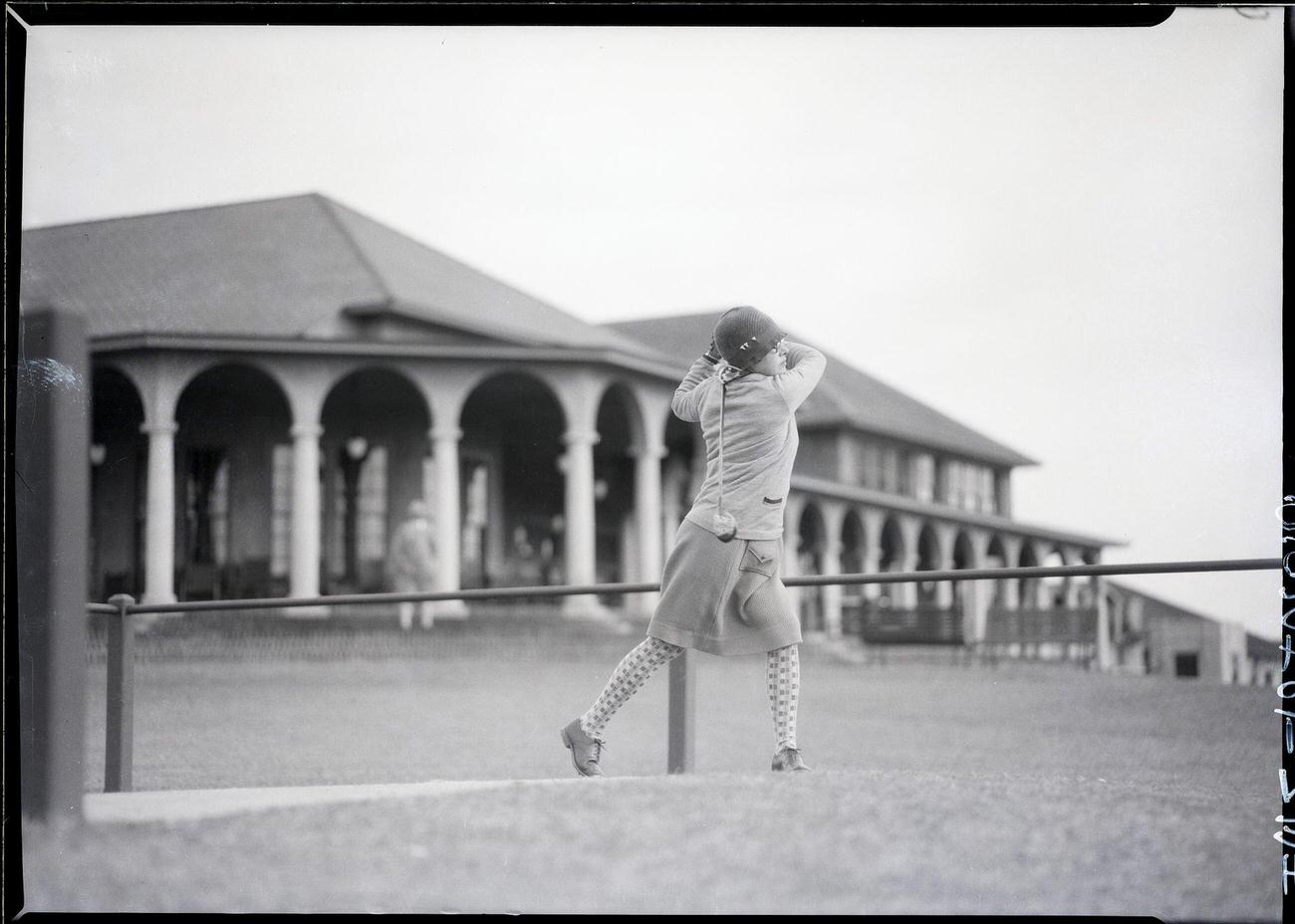
Poised at the top of her follow-through, Mrs. W. L. Pierce stands out against the broad façade of a clubhouse lined with arches, a setting that hints at the social stage on which early tournament golf often unfolded. The camera catches the moment just after impact, when balance and control matter more than motion, and the open sky behind her makes the swing feel even larger. With the title pointing to the North Carolina Women’s Championship, the photograph reads as a quiet record of competitive sport taking shape in public view.
Clothing details do as much storytelling as the stance: a cloche-style hat, a tailored jacket, a knee-length skirt, and patterned hosiery that signal an era when women’s athletics navigated both tradition and practicality. The club is held high, her weight shifted forward, suggesting a confident strike rather than a casual practice shot. In the background, a few distant figures and the long veranda add context—golf as both contest and community event.
For readers searching the history of women’s golf, North Carolina sports heritage, or early championship play, this image offers a grounded, human-scale glimpse into how the game looked and felt in its formative decades. It reminds us that progress in women’s sports wasn’t only measured in trophies, but also in visibility—being photographed mid-swing, on a course that expected spectators, and in a championship that carried prestige. Mrs. Pierce’s captured follow-through becomes a small monument to skill, determination, and the evolving place of women on the fairway.