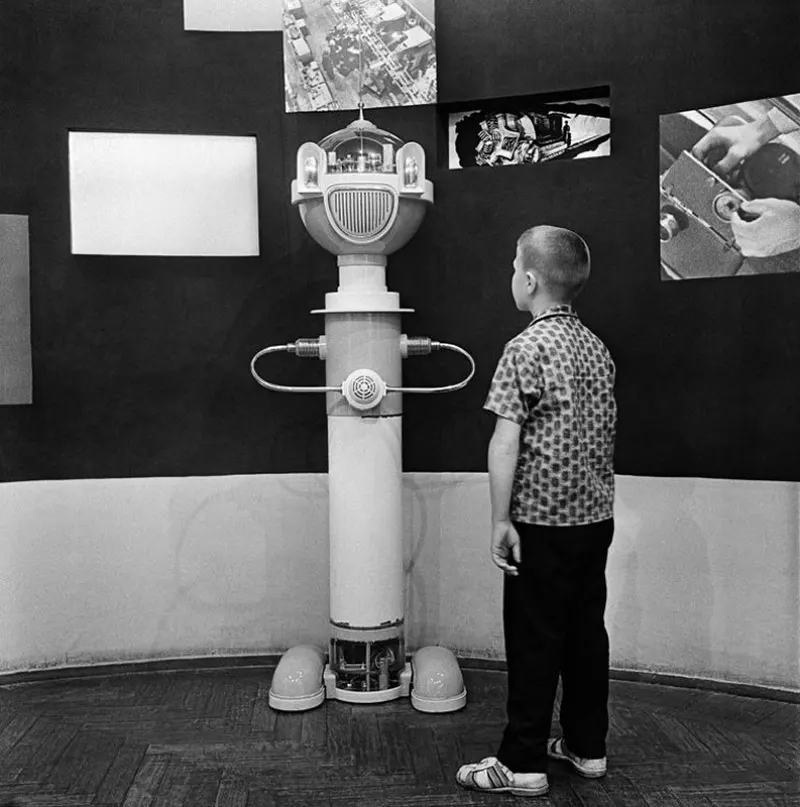
A child stands at arm’s length from a tall, polished device that looks equal parts kiosk and robot, its domed top and grille-like “face” suggesting a friendly machine built to be approached. The scene, titled “Sepulka of Soviet Union, 1962,” carries the unmistakable atmosphere of a public exhibition: a clean display wall, curated photographs above, and a single invention placed like a centerpiece for visitors to study. Even in stillness, the composition reads as a quiet conversation between youth and technology, curiosity meeting a promise of the future.
Details invite lingering: rounded housings at the base, a looped bar across the front like handlebars or a protective rail, and a small control element set where hands might naturally reach. Behind the invention, the mounted images hint at industry and mechanics—close-ups of parts, tools, and process—placing the “Sepulka” within a wider story of engineering rather than mere novelty. The boy’s posture, attentive and slightly forward, captures how museum-style displays helped translate complex Soviet-era inventions into something legible and exciting for ordinary people.
Seen today, the photograph works as more than a record of a single machine; it reflects a 1960s Soviet Union eager to showcase modern design, technical confidence, and the everyday accessibility of scientific progress. The mixture of sleek curves and practical components embodies the period’s distinctive industrial aesthetics, where utility and optimism often shared the same silhouette. For readers searching Soviet invention history, Cold War technology exhibitions, or retro-futuristic design from 1962, this image offers a small but vivid window into how the future was staged—and how it was watched.