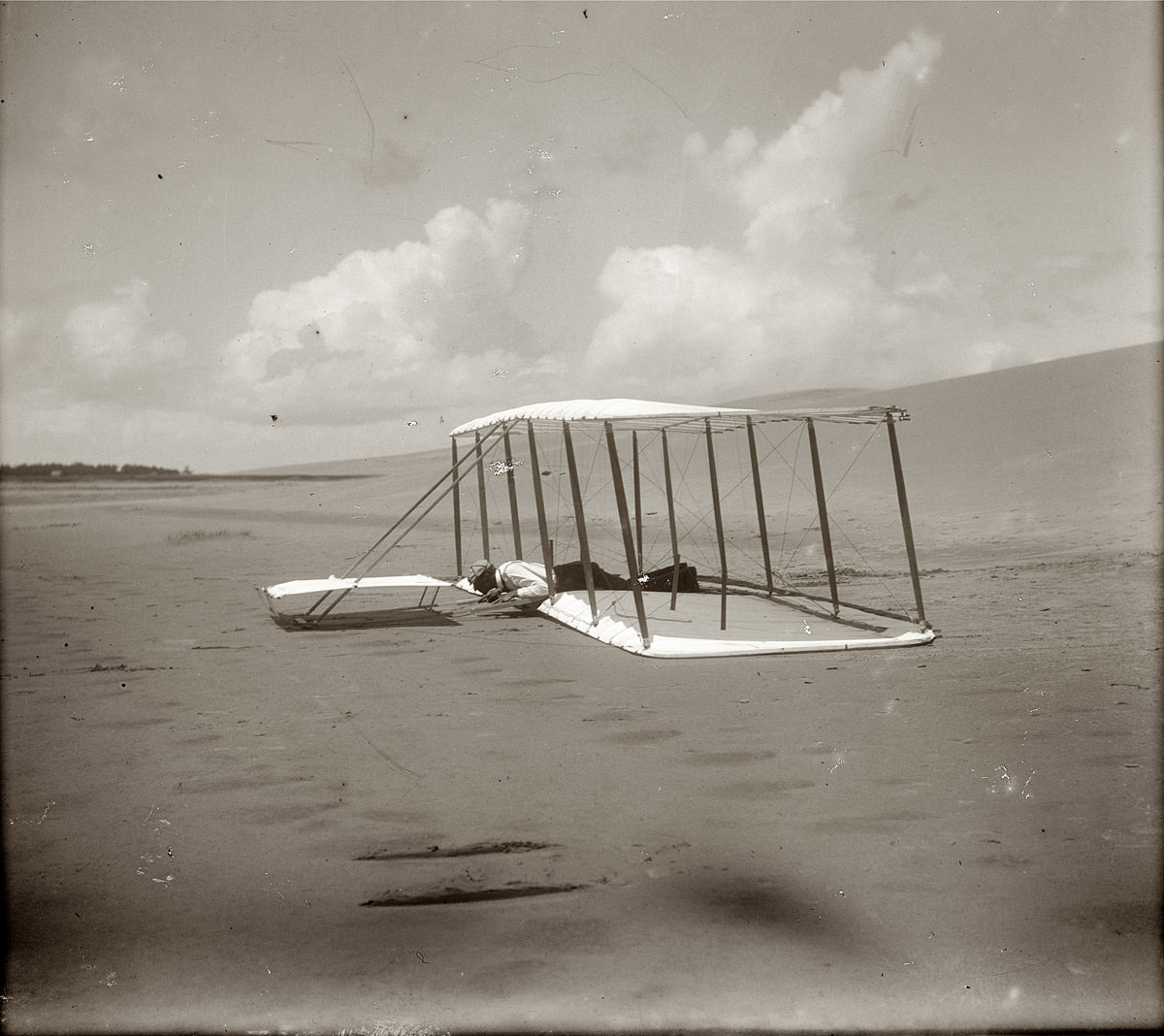
Wind-scoured sand stretches across Kitty Hawk, North Carolina, with a low ridge of dunes and a wide, bright sky setting the stage for experimentation. In the foreground, Wilbur Wright lies prone beside the glider just after landing, the machine’s fabric-covered wings and web of struts and wires resting quietly on the beach. The scene feels both stark and intimate: a lone flyer and a delicate-looking craft against an open landscape built for learning the air.
Details in the photograph draw the eye to how early flight was as much engineering as daring—lightweight framing, carefully braced supports, and a wing surface shaped to meet the wind. The glider’s position on the sand hints at the rough, practical reality of trial flights, where every landing left clues about balance, control, and lift. Even without motion, the image conveys a moment of testing and adjustment, the kind that turns ideas into workable inventions.
For readers interested in aviation history and the Wright brothers’ path toward powered flight, this 1901 Kitty Hawk view captures the quieter side of innovation: patience, repetition, and the willingness to refine what didn’t quite work. It’s a reminder that breakthroughs often arrive through incremental lessons learned in places chosen for their wind and space. As a historical photo, it offers a grounded look at a pivotal chapter in early glider experiments—one landing at a time.