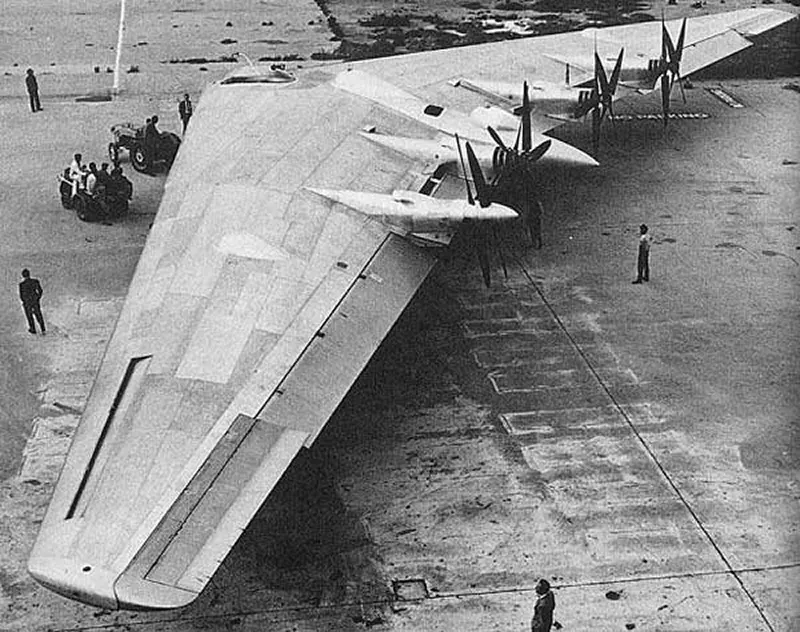
Across a stark airfield apron, the XB-35’s flying-wing silhouette stretches like a single piece of engineered audacity, dwarfing the ground crew gathered nearby. The absence of a traditional fuselage and tail turns the aircraft into a wide, clean slab of metal, its seams and panels catching the light in a way that emphasizes just how radically different this bomber concept was. Even at rest, it looks poised between experiment and weapon—an idea made tangible, then tested against the hard realities of aeronautics.
Near the trailing edge, multiple pusher propellers and compact engine housings hint at the complicated choreography required to make such a shape behave in the air. That arrangement promised efficiency, range, and reduced drag, while also demanding solutions for stability, control surfaces, cooling, vibration, and maintenance access—problems that become more vivid when you see technicians standing beneath the wing for scale. The photograph invites you to read the aircraft as a bundle of inventions: not one breakthrough, but a chain of design choices that had to work together to justify the flying-wing dream.
For anyone searching the story behind the infamous XB-35 bomber, this scene underscores why it remains so magnetic to aviation historians and engineering enthusiasts. It represents a moment when bold theory met the runway, when wartime and postwar ambitions pushed designers toward unconventional airframes and novel systems. Viewed today, the XB-35 feels less like a footnote and more like a bridge—linking early experimental aircraft design to the later mastery of flying-wing concepts that would return in modern forms.