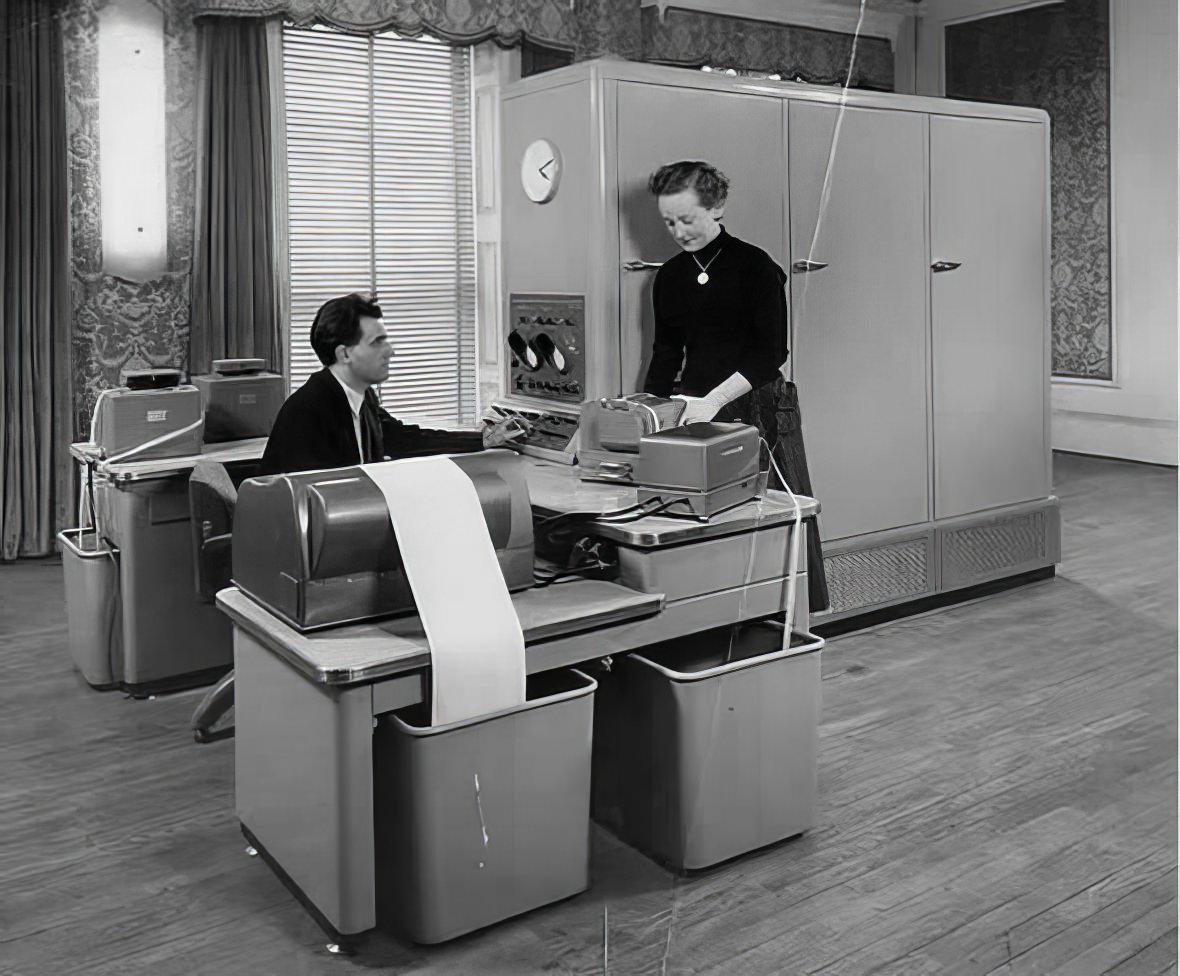
Against patterned wallpaper and tall windows, a Ferranti Pegasus mainframe dominates the room like a bank of wardrobes, its panels and dials hinting at the unseen calculations inside. In the foreground, a desk is crowded with the tools of early data processing—paper tape spilling forward, bulky office machinery, and trays ready to catch the outputs of a long run. The contrast between domestic-looking décor and industrial-scale computing hardware underscores how novel these installations once felt in everyday working spaces.
Seated at the controls, a man concentrates on the console while a woman stands nearby, consulting sheets of paper as if checking instructions, results, or the next stage in a program. Their posture suggests the collaborative rhythm of mid-century computer work, when “programming” was often a physical practice of feeding media, monitoring indicators, and interpreting printouts. Nothing here resembles a personal computer; instead, the Pegasus presents computing as a managed process—part engineering, part clerical precision.
Long before laptops and cloud services, rooms like this were the engine rooms of research, business, and government administration, where a single machine could command an entire suite and a small team. For readers interested in the history of computing, mainframes, and British technology, this image offers a vivid reminder of the scale, labor, and material culture behind early electronic calculation. It also fits neatly under “Inventions,” capturing a moment when modern information work was being invented in real time—one tape, one switch, and one careful check at a time.