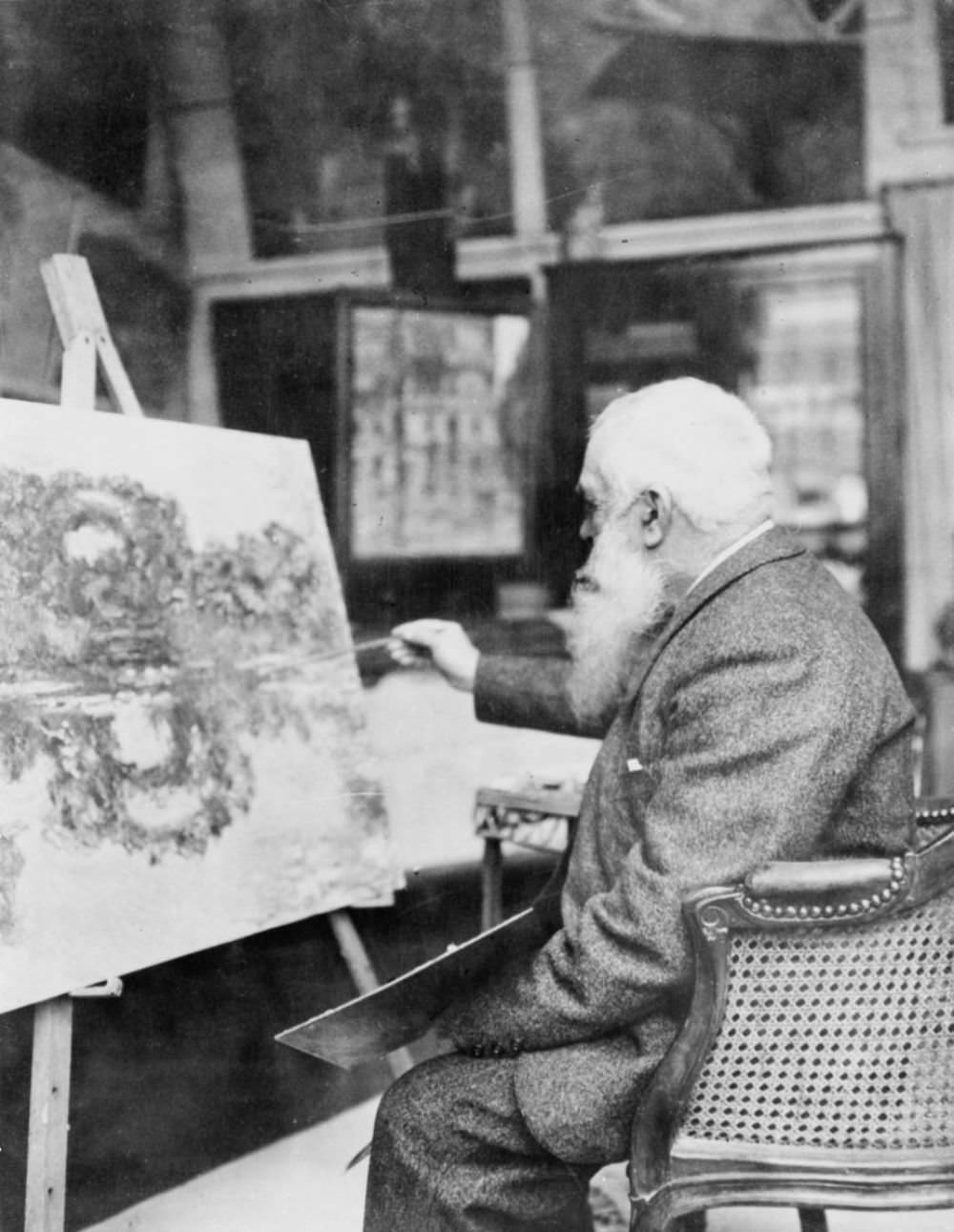
An elderly Claude Monet, beard bright against his dark suit, leans toward an easel with brush poised, absorbed in the quiet labor of seeing. The studio setting feels intimate and practical—sturdy chair, large canvas, and the muted clutter of an artist’s workspace—where the everyday rhythm of painting becomes the real subject. For readers drawn to Impressionism, this historical photo offers a rare, human-scale glimpse of the master at work rather than the finished spectacle on museum walls.
Giverny hovers in the mind as more than a village name; it is Monet’s cultivated world, a personal eden where garden paths, water, and shifting light supplied endless motifs. Even without bright color, the blurred, lively marks on the canvas suggest the same obsession with atmosphere found in his garden paintings, as if the studio were simply an extension of the outdoors. The connection between place and process comes through strongly here: the garden is not just a backdrop to the artworks, but a wellspring that fed the studio day after day.
For a WordPress post exploring “Claude Monet’s Personal Eden: The Studio and Gardens of Giverny Artworks,” this image sets an evocative tone for anyone searching for Monet studio photos, Giverny history, and the story behind the paintings. It invites a slower reading of his work—how observation becomes brushwork, and how a designed landscape becomes an artistic laboratory. Seen this way, the gardens of Giverny aren’t merely famous scenery; they are the living instrument Monet tuned into art.