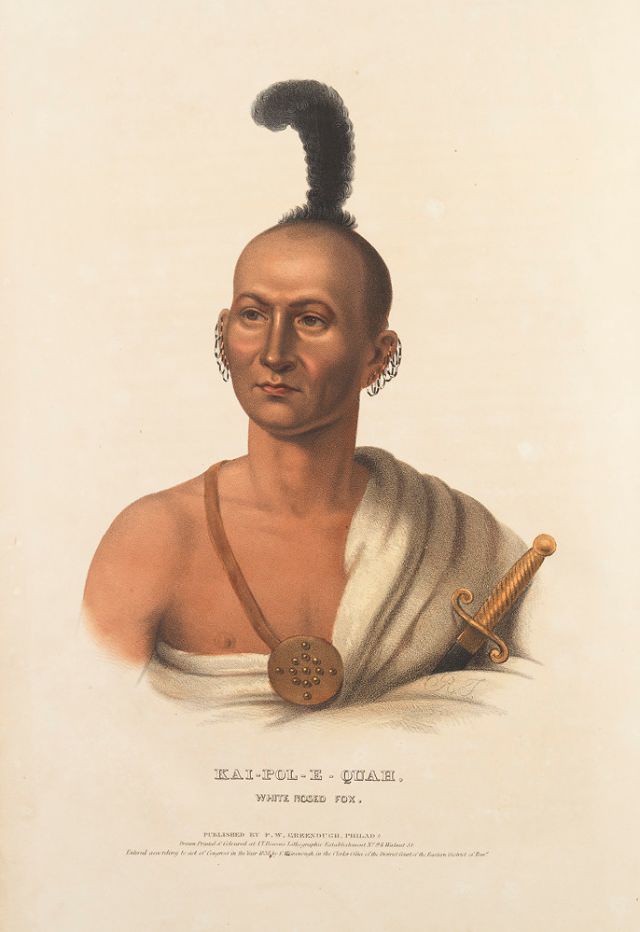
A poised, three-quarter portrait introduces Kai-Pol-E-Quah, also identified by the English epithet “White Nosed Fox,” rendered with the careful polish of a 19th-century print. The sitter’s calm gaze, closely shaven head, and upright plume-like hairstyle draw attention immediately, while the warm skin tones and soft shading give the artwork a lifelike presence against an uncluttered background.
Details of dress and adornment provide much of the story: a draped cloth held by a round brooch at the chest, prominent ear ornaments, and the hilt of a sword angled into view at the right edge. The composition balances dignity and display, inviting readers to consider how Indigenous identity was pictured for distant audiences—through a mix of personal markers, selective regalia, and the artist’s own visual conventions.
Beneath the figure, the printed caption “KAI-POL-E-QUAH, WHITE NOSED FOX” anchors the image as a named portrait rather than a generic “type,” making it especially relevant for those researching historical artworks, ethnographic illustration, and early portraiture in print culture. For WordPress visitors searching terms like “Kai-Pol-E-Quah,” “White Nosed Fox,” or “historical portrait print,” this post offers a focused look at a single sitter presented with striking clarity and enduring authority.