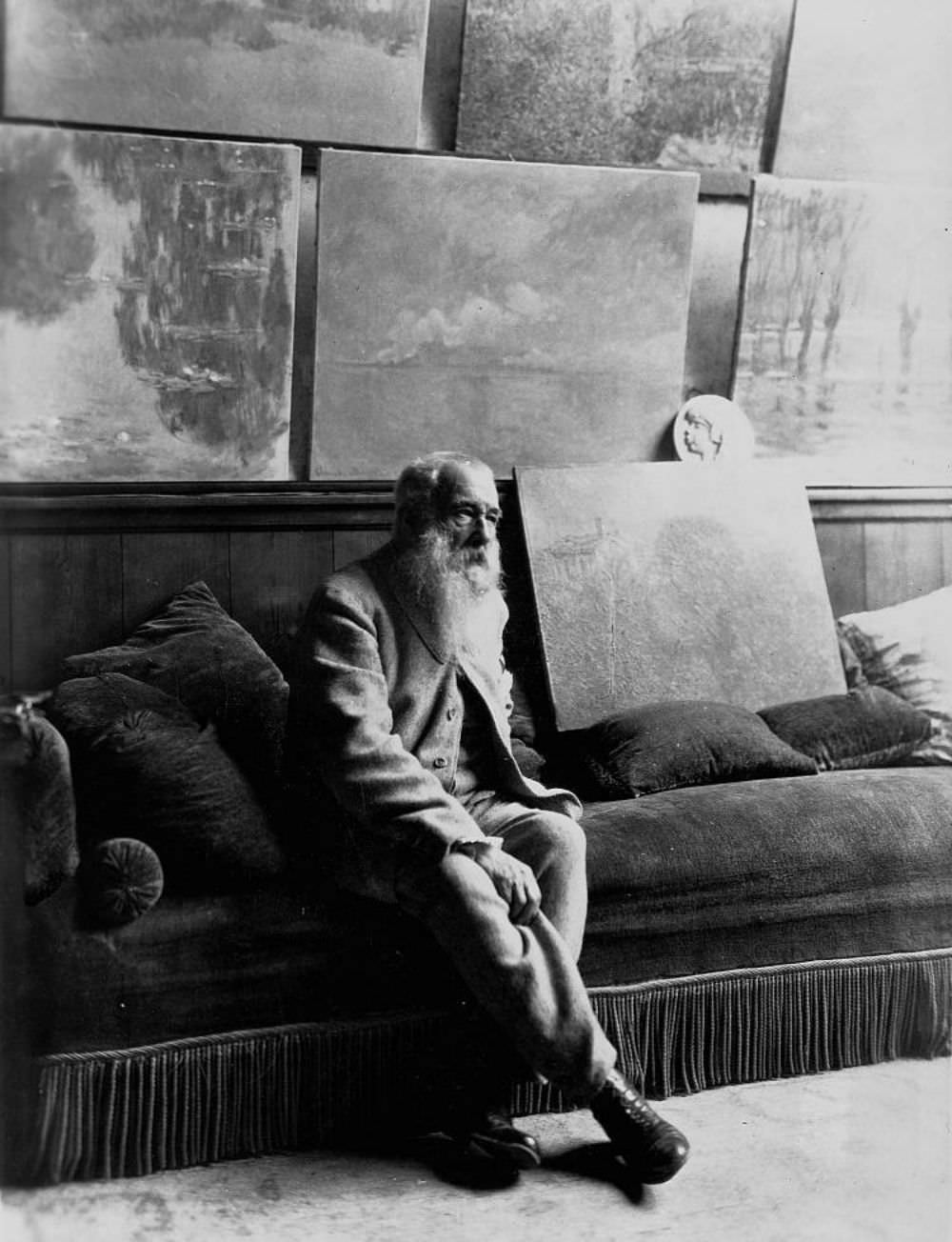
Against a wall crowded with canvases, an elderly, bearded painter sits in quiet repose on a long sofa, as if pausing between bursts of work and reflection. Several paintings lean and overlap behind him—misty water, softened horizons, and vertical trunks suggested with quick, atmospheric strokes—creating a lived-in studio scene where art is stacked like memory. The photograph’s intimate composition turns the workspace into a portrait of process, not performance, with unfinished surfaces and studio clutter speaking as loudly as any finished masterpiece.
Giverny, so closely linked in the public imagination with Claude Monet’s gardens and his pursuit of light, feels present here even without a view of the pond or the flowerbeds. Those hazy studies of sky and water evoke the motifs that made his personal Eden famous, where seasonal change and shifting weather became daily subjects. The setting suggests a rhythm of looking, painting, revising—an artist surrounded by the very experiments that would later define the look of Impressionist and late-Impressionist landscape.
For readers drawn to “Claude Monet’s Personal Eden: The Studio and Gardens of Giverny Artworks,” this historical image offers a rare, grounded counterpoint to the myth of effortless beauty. It hints at the labor behind the luminous surfaces: canvases stored upright, sketches and studies kept close, and a studio that functioned like an extension of the garden itself. Explore the artworks with this scene in mind, and Giverny becomes not just a destination, but a working world where observation, patience, and repetition shaped every bloom, reflection, and veil of light.