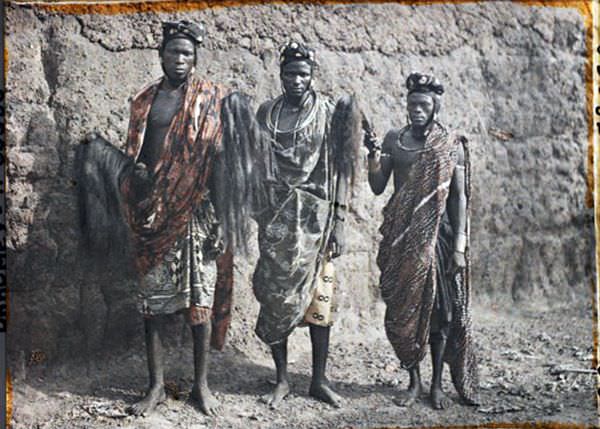
Warm earth tones and careful colorization pull the viewer into Dahomey—now Benin—in the 1900s, where three figures stand posed against a rough, sun-baked wall. Draped cloth wraps their bodies in layered folds, and the fabric’s texture reads as both practical and expressive, suggesting status, identity, and everyday comfort in a hot climate. The scene feels quiet and intentional, as if the photographer asked for stillness and the sitters answered with dignity.
Clothing details do much of the storytelling here: patterned wraps, head coverings, and visible adornment hint at local aesthetics that long predate the camera’s presence. Bare feet on dusty ground emphasize the immediacy of the setting, while the weathered backdrop—cracked, uneven, and handmade—anchors the portrait in a lived-in environment rather than a studio fantasy. Even without a named location, the title’s reference to Dahomey places the image within a region shaped by powerful kingdoms, trade networks, and rapid colonial change.
For readers searching for early 20th-century Benin history, this colorized photo offers more than a simple “then and now” comparison—it invites a closer look at material culture, posture, and the politics of being photographed. Color brings new emotional access to an old print, helping modern eyes notice cloth tones, skin warmth, and the play of light that monochrome can flatten. Taken together, the portrait stands as a small but vivid doorway into Dahomey’s past, encouraging us to consider whose stories were recorded, how they were framed, and what still speaks through a century-old gaze.